
Chapter 7: Camp Life
By late March 1942 all Japanese internees, except those from New Zealand and those local Japanese interned later, had arrived at the camps. A common first impression was of the barbed-wire fences. At Loveday, Tatsuzoo Iamizumi recalled:
The camp at the time of our arrival consisted merely of a double row of barbed-wire fences all around. The Loveday site of that time looked like a desert land with nothing but sand all around as far as the eye could see.1
Overseas internees, particularly those who had had a bad voyage from New Caledonia or NEI, found arriving at the camp a relief. Imaizumi wrote: “Although desert storms were frequent occurrences we were happy to find at last a resting place.”2
The internees had to make many adjustments to the new climate, diet and neighbours. Most of the Japanese were from tropical to subtropical areas and they found the climate very different. At Loveday Shigeru Nakabayashi experienced a sandstorm for the first time. He said:
The area had almost no trees. There was only saltbush. Almost every day there was a sand storm … the red soil was a terrible thing. It got in everywhere.3
Even in summer the temperatures were low at night. Peggy Shiosaki remembered: “It was so cold. I was all rugged up in blankets and things but still felt cold. We weren’t allowed to use any heating.”4
Camp life followed an artificially imposed rhythm. Internees did not have to worry about making a living, as shelter, food and other basic needs were provided for. Masuko Murakami from Darwin recalled:
I had three sons. Two were born in the camp. The oldest was three years old when we were interned. I was busy looking after my babies … a full-time mother. That’s all I can remember now. There wasn’t much else to do or worry about. We didn’t have a pram or cot or anything like that, but nappies were supplied and there was plenty of milk.5
Children found camp life interesting. Joe Murakami was 14 in 1942:
The camp life served to broaden the hitherto narrow horizons of the children brought about by the lack of cultural amenities and opportunities in such places as Broome, Darwin, Thursday Island, etc. I think we children rather enjoyed this new interesting communal life.6
Peggy Shiosaki agreed:
I had never been out of Broome, so at first it felt a bit strange to see so many people who I had never met before. We lived together with people of all sorts of nationalities who had different ways of doing things. I remember the Indonesian Japanese did washing differently. They washed clothes on the table. But we had to adjust to each other.7
Former internee children have many stories. Alf Shiosaki, 12 at the time of internment, sneaked out through the barbed-wire fence with two other friends and went to a local ice cream shop:
Jack and Doochi and myself … We had a few shillings … went in the shop … The man at the counter was suspicious about us and said, “Where are you boys from?” Jack was smart, you know. He said, “We’ve just arrived from Geraldton. We work at a tomato farm.” At that moment Doochi put his head in the door. He had a typical Japanese face. At first we didn’t want to take him. But the man sold us ice cream … We went back to the camp and the next day we had to face the camp commandant. He said, “You know those men in the sentry box. They are good shooters.”8
Some suffered and failed to adjust to the new life in the camp. At Loveday two attempted suicides were recorded up to 27 November 1942.9 The first was in February 1942 when it was claimed an NEI internee in 14B attempted to bite off his tongue. He left the camp on the prisoner exchange in August 1942. The second was a Formosan internee in 14C in June. Tatsuzoo Imaizumi remembered him:
Various problems of different characteristic nature could be expected in such misplaced surroundings … A person who suffered from some kind of frustration and who attempted to commit suicide by taking creosote, but was fortunately saved through the quick action taken by the Medical Service.10
In the same month there was a successful suicide. A New Caledonian internee swallowed glass. He was admitted to the camp hospital but died there. Whether more suicides were attempted after November is unknown.
Many former internees said that they were given a lot of freedom inside the perimeter. They celebrated almost all Japanese holidays, including New Year’s Day, the Emperor’s Birthday and National Foundation Day. On 8 December 1942 Japanese in all camps had a ceremony on the first anniversary of Japan’s entry into the war. The Loveday war diary recorded that Japanese in 14B Compound refused to go to work because they wanted to celebrate Pearl Harbor Day.11 At Tatura Mori noted:
At 7 a.m. we all gathered and paid respects to the dead soldiers and wished good luck and success to the Imperial Army. We had a special concert at 6 p.m.12
For the children Japanese ceremonies were just occasions for eating special food. Peggy Shiosaki recalled:
The party was fun. They cooked a special meal and made various sweets. The Emperor’s Birthday … didn’t mean much to me. I did what others did … bowed to the sun. They (the Japanese) really did it seriously.13
According to Jessie Banno, a New Zealander who became a Japanese national through marriage, “old men in the camp were patriotic. Events of a patriotic nature were held by the Japanese for the Japanese. Those who were of other origin usually stayed away.”14 Ethel Punshon remembered one incident where an Australian-born internee, the daughter of a mixed marriage, refused to bow in the direction of the Emperor in Japan. The compound leader pushed her head down but she slapped his face.15 Zenichiroo Satonaka, a former internee at Loveday, described a similar incident. He said:
I was only 19 years old and didn’t understand what the bowing to the sun meant. I probably didn’t bow properly or something. One man came up to me and said, “Sore demo Nihonjin ka?” [Are you really Japanese?]16
As the camps were bare and desolate, many people made basic comforts. There was no shortage of craft skills among the Japanese internees. There were professional carpenters, builders, blacksmiths, gardeners, tailors and cooks. The Japanese worked at improving their environment from the beginning of their internment. Gardening was very popular in all camps, Japanese, Italian and German. However, according to former guards, the Japanese in 14C at Loveday created particularly elaborate gardens.17 Taroo Ishii wrote:
Our camp life was in the middle of flat dry land. We used to look for green weed and plant it in front of our tent. We were so desperate for greenery. Major MacRae, commandant of our compound, pitied us and gave us cosmos seeds.18
According to Ishii, Bunjiroo Sengoku, a professional gardener in NEI, took the lead in planning the gardens. The Japanese planted shrubs, cacti, flowering plants and ground covers, and landscaped mounds and ponds. They collected tons of limestone rocks to edge the gardens and used scrap timber to build shrines and a tea house. Bob Margitich praised these gardens highly:
If you went across to the Italian or German compounds at No.14, there was only bare earth … They suffered their internment. There were probably two reasons for doing that (gardens and shrines). One is that they wanted to worship and the other is that it gave them something to do.19
A strong memory former guards have of older Japanese internees at Loveday is that they were always busy skilfully making things. According to Nakabayashi, who was at 14C, many of the older men were good at making things from waste materials.20 Among the most practical articles they made from scrap wood were geta [wooden footwear]. Hand-made geta were also worn at Tatura and Hay.21 At Loveday, mallee root was a favourite material for carving various objects. Internees also planted cane in their compounds and used it to make baskets and fences for their gardens.22
The PWJMs at Hay were generally younger than the Japanese at Loveday. Most had been pearl divers. There was a vegetable garden in their compound. Harold White wrote: “They cared for their garden, played baseball and had various hobbies, some made trick boxes of which I was given one, also they gave me vegetables from time to time.”23 However, they did not improve their compound by making elaborate gardens as the Japanese at Loveday did.24
At Tatura too the Japanese were interested in gardening. Some older people were good at making various articles from waste materials, including geta.25 Jim Sullivan recalled:
Old army boot tops were used to make uppers for clogs. Some weren’t happy about this, thought they were assisting the enemy. But in actual fact they were used in camp kitchens, the wooden soles kept their feet warm while working on concrete floors.26
Camp authorities organised picture nights for the internees. According to Nakabayashi, at Loveday Charlie Chaplin’s pictures were often shown.27 At Tatura, a Mr Walker brought his projector to all the camps, including the POW camps, about once every 3 months to show films.28 Peggy Shiosaki recalled:
I remember Mr Walker very well. He came from Melbourne and showed us a picture. It was something I looked forward to very much. Everyone knew Mr Walker very well.29
Jim Sullivan also showed films to the Japanese internees:
An old Japanese projector was in the camp store room. It came from Broome. One of the internees told me about it so I asked Scurry if I could get it out and use it in the compound. Permission granted. There were also some Japanese films with it which I used, but they played up a lot with breaks, however there were happy nights out under the stars in D Compound, and I was always provided with a nice supper by the young girls.30
In all camps internees were allowed to play sport. Sporting equipment was available and the Japanese played various games. Baseball and sumo wrestling were popular at the men’s camps.
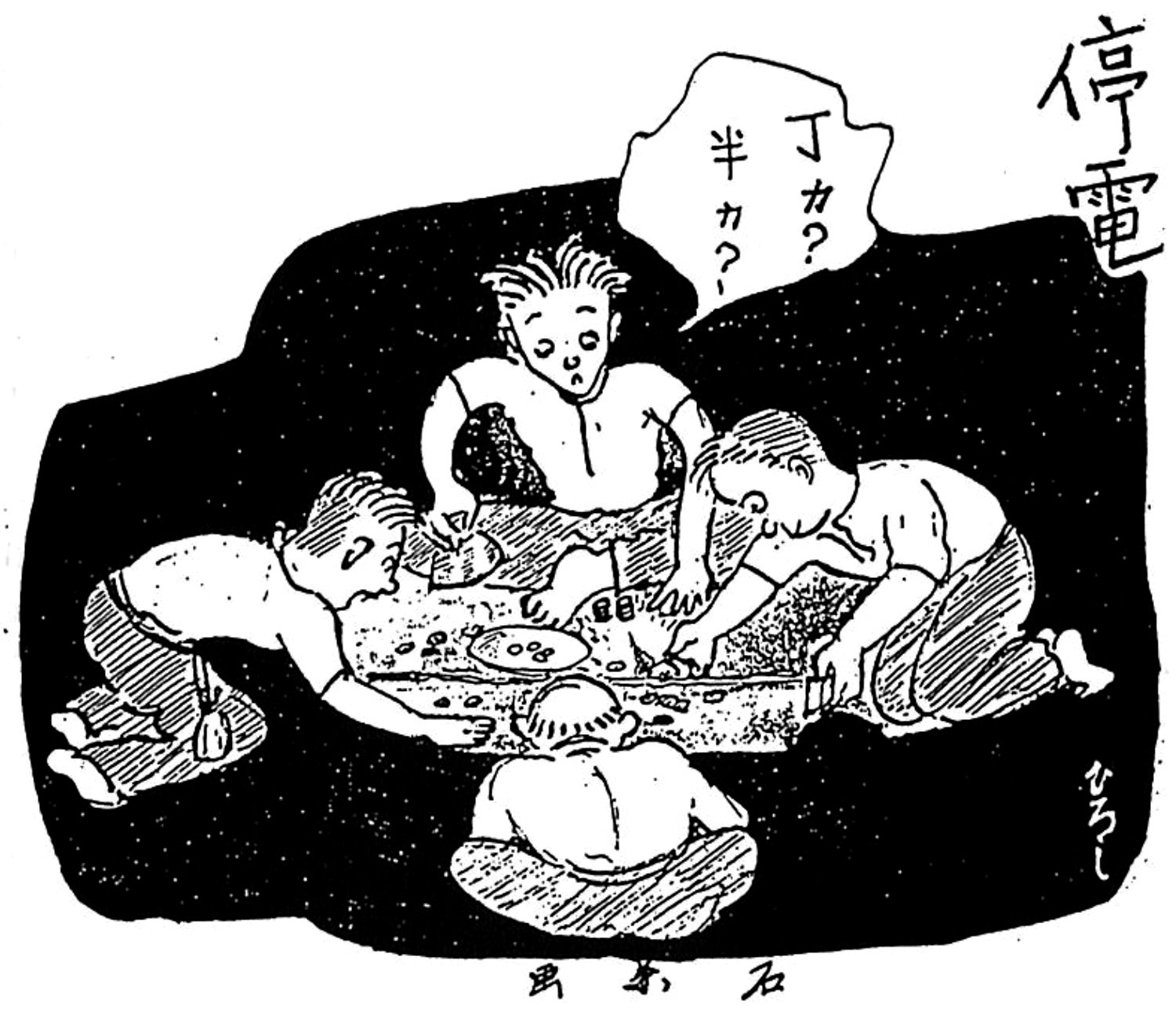
Image of illustration with Japanese text ‘Mah-jong was one of the popular pastimes among Japanese internees at Loveday’ by Mr Ishikane
Baseball leagues were organised, with each team usually formed according to its members’ place of origin. Shigeru Nakabayashi at Loveday said:
Life in the camp was boring so we got a lot of pleasure out of playing baseball. I was working in the kitchen. We, the kitchen staff, formed a team called “All Kitchen”. There were other teams such as “All Borneo” and “All Molucca”. Tennis balls were available, but we couldn’t get baseballs so made our own. We wound layers and layers of bacon-bag string on tennis balls. It worked well.31
Sumo matches were frequently held at both Loveday and Hay. The wrestlers wore embroidered aprons showing the name they competed under. They usually used the name of their birthplace in Japan. At Hay many PWJMs were from Wakayama and one wrestler was named “Kumano Nada” [Sea of Kumano],32 the sea beside Wakayama. Other internees, particularly the Australian-born, played games like tennis and cricket. At Woolenook the Australian-born often had games with the guards. Jimmy Chi from Broome recalled:
A paddle boat used to pass near our camp. In the early days the tourists on the boat were cautious, but after a while they became friendly, often visited us and played a game of cricket with us. I suppose they were relaxed after they knew that we spoke Australian.33
Mah-jong and hanafuda [flower cards] were favourite pastimes at Loveday and Hay. Both games were played in small groups. Chinenji Kaino at Hay said:
Our group had a mah-jong set from Broome. Nothing to do. We played it a lot. We bet money and cigarettes. While we played, we sometimes talked and speculated about the war.34
According to Shigeru Nakabayashi, internees made their own mah-jong sets from scrap timber, and their own hanafuda cards. In the tents in the early days they stayed up late playing mah-jong by the light of home-made lamps. Nakabayashi described the lamps:
We couldn’t use the oil lamps as the supply of oil was limited and soon used up if we used it to stay up after “Lights Out”. So we made our own little lamps. We had tons of fat from cooking, put some of it in one tin and put another tin with a little hole over it, and put through a bit of cloth to burn … our tent became black inside. We were not supposed to use things like that.35
At Tatura popular sports were tennis, baseball and softball. They played tennis on a clay court which they constructed themselves. Competitions were often held with other compound teams.36
Engeikai [concerts/variety shows] were held in all camps. Internees’ committees organised performances periodically, usually to celebrate Japanese national holidays and special occasions.37 Theatre groups were formed. At Loveday, a group called Shinsei Gekidan [Newly Born Theatre Group]38 in Compound B produced many kabuki plays.39 They made elaborate costumes using whatever material they could obtain.40 As no women perform in kabuki, female parts are taken by male actors called Onnagata. Zenichiroo Satonaka, a former internee from NEI, was one of the youngest internees in 14B and an Onnagata actor. He recalled:
I enjoyed acting. Because I had fair skin, I was asked to do Onnagata. Old men liked me. They brought milk and fruit to my hut. Some gave me pocket money too.41
At Hay the PWJMs often invited the camp commandant and the guards to their shows. Hoshikawa, the compound leader of Number 6, sent the following invitation to the camp commandant:
Our Concert is to be held on Friday and Saturday afternoon of this week at No. 13 Mess. I am sure there will have some humorous play. Hoping you will be able to attend the Concert which will begin at six o’clock sharp. I have annexed the programme of the Concert herewith.42
The Friday evening program included Japanese Bon dancing and four dramas, including a comedy entitled “Examination of Marriage”, and a Kabuki play entitled “Kunisada Chuji”. As the plays were in Japanese, a synopsis of each drama was given in the program. It read:
There are two boys and these two boys are against one another to marry the girl who is the daughter of the boys’ aged school master, which who will win her hand?43
Chinenji Kaino played female roles. He recalled:
First I was very embarrassed, but got used to it. We were all men, so somebody had to do it, I suppose. We made traditional female wigs and costumes using paper and cloth.44
Harold White was among the guests on one occasion:
… it was so slow and drawn out it went for about 4 hours, we did not want to disappoint the actors or be ill-mannered so stayed for about 3 hours then left. Of course, we did not understand a word of the language, so I think we did pretty well. I sometimes wonder if anybody escaped while we were watching the “show”.45
Concerts were also a major entertainment in all compounds at Tatura.46 Each compound planned its own and invited the others. Occasionally the Japanese and the Formosans held a joint concert. A program usually included dances and songs by children and adults. The Australian-born thought some of the dances and songs were “unbearably boring”. Peggy Shiosaki recalled:
Concerts were a lot of fun. I liked the Chinese dancing the best. It was very colourful. The Japanese did sword dances and a lot of singing. The women’s singing was pretty good. They had rhythm. But the men’s singing was awful, particularly the one who did it with a glass of water. He had no rhythm and sounded as if he had a stomach problem. We walked out. That annoyed the Japanese.47
The children also enjoyed watching the Ueno Circus practise. The Ueno Circus had travelled with Wirth’s Circus before the war broke out. In Jim Sullivan’s words, “They were an outstanding group of world class.”48 Sullivan wrote:
Doris Wirth, the great circus owner, called to see them with an elephant and for the children to see, also the one who used to go up and down the ladder on his head, no hand assistance.49
He was Kaichi Namba, who had performed with other troupes around the world before the outbreak of the war in Europe. He was the centre ring feature with this skill and was performing in Australia when Japan entered the war.50
Outside activities
Two or three times a year, picnics to the Waranga Reservoir, about a mile away, were another highlight of camp life at Tatura. According to Jim Sullivan, “This picnic was organised only when the weather was good and an officer was available.”51 Sullivan accompanied the Japanese on most of these picnics. He remembered: “They brought home bags of mussels and yabbies.” Peggy recalled:
We lived inside the barbed-wire, so it felt so good to be out … We were taken out only one compound at a time. One guard and one warden came with us. It was a lot of fun. We picked mushrooms.52
According to Harumi Yamashita, the second-eldest daughter of the Yamashita family who worked in the camp office, Germans and Italians were taken out more frequently than the Japanese and the camp administration was reluctant to let the Japanese internees out too much even after the war ended.53 Don Vallance, a former guard, confirmed this: “Even though it was in 1947 the guards used to be spread out each night around the fence to keep them (the Japanese) all in.”54
With the camp commandant’s approval, other adult internees could study, borrow books and textbooks, and take university and correspondence courses, but these privileges were denied Japanese internees.55 Nevertheless, former Japanese internees state that the Japanese were allowed to conduct some educational activities by themselves in their compounds.56 The authorities thought it desirable to encourage internees to engage in such activities to exercise their minds.57 At Loveday, Japanese and Malay language classes were conducted by internees. These kinds of classes were not offered at Hay, where the majority of PWJMs spoke only Japanese.58
At Tatura there were 361 Japanese children.59 The education of children was an important part of the administration of each compound, so a kindergarten and camp schools were established. Classes were taught by suitably qualified persons selected from among the internees, supervised by a military officer. Teachers were paid at the same rate as all other work.60
The policy permitted state school correspondence courses for children, including Japanese children, up to 18 years of age.61 An English class was also held using one hut in C Compound. It followed the Australian government correspondence school guidelines. Evelyn Yamashita, 14 in 1942, attended the English school for a short time. She said:
There were one or two women in the compound who were qualified to teach primary school, but no one could teach high school level. So I couldn’t get any help with my studies.62
At the beginning each Japanese compound had its own Japanese school, but, possibly due to the reduction of the number of children occasioned by the prisoner exchange in August 1942, the Japanese school in C Compound accepted children from B and D Compounds.63 The Formosans had their own schools, Chinese, Japanese and English, in their compound.64 Alice Pao said:
My mother said to me, “You have to learn Japanese as Japan might win the war and also you must learn English because it is an international language.” So I was sent to both Japanese and English schools.65
The Japanese school in C Compound was run jointly by C and D Compounds where most of the adults were Japanese nationals with more patriotic and militaristic views. They stressed the virtue of emperor worship. Policy recognised that instructors would have to be drawn from the ranks of the internees and that such instructors would tend to postulate nationalistic doctrines and patriotism. From time to time the scheme was criticised on that account, but such a defect was unavoidable and was best controlled by local camp authorities using their common sense.”66
The children in the camp spoke various languages, including English, French, Dutch, Indonesian and Japanese, and some were bilingual. Sullivan recalled:
The language problem was funny, particularly out of school, some would speak to you in French with a little bit of Japanese or Indonesian or some other language all mixed up. But they seemed to manage.67
The main task of the Japanese school in C Compound was to teach Japanese language and culture. The father of Taishiro Mori became the headmaster of the school and he himself was one of the teachers. He said:
Eighty-five per cent of the pupils were of mixed origin and had various language backgrounds. It was extremely hard to think of a good way to teach Japanese. I had to teach them from the Japanese alphabets. I thought of teaching Japanese sounds through songs, so I decided to learn how to play the organ. I learnt the organ from Mrs Chen after I finished teaching. I was never good, but good enough to play a simple tune.68
The Japanese teachers forbade popular Japanese songs: only military and children’s songs were sung.69 Saburoo Kanegae from Broome, who was 11 in 1946, learnt a military song called “Umi Yukaba” [Going over the sea] at the school:
At sea be my body
water-soaked,
On land be it with grass
overgrown,
Let me die by the side
of my Sovereign!
Never will I look back.70
Mari Kai, from New Caledonia, was a student at the school. She talked about her teacher, Mori:
He was a very strict teacher. I only knew a few words of Japanese when I first went to the camp school. I used to speak French with my friends from New Caledonia … He hit me on the head when I spoke French at school.71
Sullivan wrote about Mori: “Mori sure was strict. We had nothing on him and some of the others.”72
The curriculum was decided on by the teachers and committees and reflected the ideology of nationalism and militarism prescribed for elementary schools in Japan.73 The textbooks were written by the teachers and included reading passages generally of patriotic nature. By 1945 Mari was able to read advanced Japanese from Volume 12. The first lesson consisted of poems by the Emperor Meiji, such as:
Looking at pages from the past,
how is my land now
I wish my mind was as vast and clear
as the blue sky.
The mountain emerges in the clouds
but you can reach the summit if you try.
I am made greater by the striving
of each and all of my people.
Keep the good and reject the bad,
we will build a nation second to none.74
The third lesson was on Charles Darwin:
Charles Darwin was born in England about 100 years ago. He had a strong interest in plants and animals from an early age … his father sent him to university hoping that he would become a doctor … but he started research in natural history … He studied animals and plants for many years and developed a theory that all living creatures evolve over a long period. This is his famous theory of evolution which shook the academic world to its foundations.75
Mori, who was instrumental in producing the textbooks, still treasures those he wrote in camp. He said:
I taught shushin [moral education] to the children through various readings and talks. I taught them that one nation is a big family. This was helpful for them to understand the relationship between the state and the individual.76
His words follow those of a statement by the Japanese Ministry of Education in The Fundamentals of Our National Polity, issued in 1939:
Our country is a great family nation, and the Imperial Household is the Main Family of the subjects, and the Emperor has been the center of national life from the past to the present. Thus the Emperor and his subjects are united into One.77
Inevitably there were differences of opinion between parents regarding the education of their children. Not all parents sent their children to the Japanese school: only 68 out of 141 children (C and D Compound combined) were there in April 1944,78 but not all 141 were of school age. Alf and Peggie Shiosaki in D Compound were not interested in learning Japanese. According to Peggie, their Aboriginal mother never forced them to go to the school.79 Saburoo Kanegae’s father, in B Compound, was very patriotic and strict about his children speaking Japanese, so Saburoo learnt Japanese in the Japanese school.80 The Kai family from New Caledonia were originally in B Compound but later moved to C Compound. Their daughter Mari went to the Japanese school.81 Takeichi Minami, from New Zealand, was a teacher and later became headmaster after Mori’s father. He said:
B Compound children didn’t come to the Japanese school. Many of the people in B Compound were Australian … They were a little different from us and thought they were superior or something. People who had Japanese nationality were all loyal to the Emperor.82
Yooko Tsushima, born in New Caledonia to Japanese parents, also went to the Japanese school. She said:
I didn’t know a word of Japanese, but my parents sent me to the Japanese school … One day I asked Mum to send me to the English school, but she got very upset and said to me, “Don’t you ever say that to your father. You have to learn Japanese … Japan is going to win this war …”83
Former internees suggest that there was friction between B and C/D Compounds.84 Yuri Murayama of B Compound observed:
There was not much communication between B and C/D, apart from occasional sports and concerts. We didn’t have much to do with them. Many of us didn’t go through a Japanese militaristic education. Eventually we taught Japanese in our compound. It wasn’t a proper school, just a small tutorial group.85
Evelyn Suzuki remembered one incident which occurred in B Compound. She wrote:
Young people in C Compound were invited to a dance in B Compound one night. A jealous boyfriend from C Compound came and caused a disturbance claiming we were disloyal to Japan. He raved on about how the youth of C Compound were being led astray by our decadent ways of the West while Japanese soldiers were laying down their lives for the Emperor. There were no more dances held after that.86
The leaders of C and D Compounds seem to have agreed on most matters and combined for many activities. Young men in C/D Compounds formed a Seinendan [Young Men’s Association]. The young men were, in Mori’s words, “future soldiers of the Emperor’s Army”.87 On 16 May 1942 Mori, a member of the Seinendan, noted in his diary:
Today’s training was cancelled because of rain. We (Seinendan) tend to fall into the lazy and irresponsible life of prisoners. We must not let it happen, but must work hard at converting our minds to pure Japanese spirits … Thinking that our comrades are fighting for the country day and night, I bow deeply to them.88
Training was usually before breakfast and included sprinting and long-distance running inside the compound. Trainees were also drilled by Tomoeda, the leader of C Compound and a former warrant officer, who had been arrested in Borneo where he had an engineering contracting business.89 Former internees of C Compound remembered him as a very strict but capable leader. Sullivan remembered him: “Tomoeda was strict on the evening roll call. When the handover took place he would have them all lined up like soldiers. He always saluted.”90 An intelligence officer described Tomoeda as “one of the best parade-ground officers”.91
Three people served as leaders of D Compound. The first was Miki Tsutsumi from Broome. Later a difference in views between Tsutsumi and other members of the committee in D led to his moving to B Compound.92 Yasukichi Murakami from Darwin, Joe Murakami’s father, held the position until he died of illness in 1944, and Mr Ishikane from NEI served as the third leader until the end of internment. Joe Murakami wrote:
Among the adults, camp life must have been very trying because there were numerous differences of opinion and constant friction. I don’t know what went on among the adults. My father, together with some others, requested … to be allowed to transfer from B to D Compound. This request was granted and we moved to D Compound. Subsequently, my father became Section Leader.93
The atmosphere of B Compound was, in the words of Yuri Murayama, “more democratic”. The compound leader was Albert Ueno, leader of the Ueno Acrobatic Troupe. He was a Japanese national but had spoken English since he was 5 when his father, the founder of the troupe, took him on a world tour.94 His running of the compound was, according to Jim Sullivan, “more Westernised” than other leaders. Jessie Banno was in D Compound but knew him very well. She said that “he was a very open man and prepared to discuss various matters with the AMF”.95 When Ueno finished his term as leader, he was replaced by Haruyoshi Yamashita, the owner of the soy sauce factory from Thursday Island.
B Compound accepted internees labelled “troublemakers”.96 One family had a lot of friction with the Japanese. The father was Japanese and the mother of Spanish English extraction. They had six children, all Australian-born, one of them in camp. The mother and the two older daughters had the most trouble. Their outspoken and open behaviour offended many Japanese in the camp. Because of this, the family was transferred to one compound after another. Finally they settled in B Compound. The eldest daughter, said:
My younger brothers mixed well with the Japanese, but we older ones couldn’t. I hated Japanese. The best were the Formosans in A Compound. They were not arrogant and they were friendly.97
She had little in common with the Japanese. She described an incident which upset many Japanese:
We were bathing together with other women. A Japanese man came in, so I threw a bucket of water at him … It was a Japanese custom to have a male attendant even in the women’s section. Other women didn’t mind it. My father was really embarrassed at that one.98
At Loveday some friction developed between Japanese internees of different backgrounds. The evidence suggests that there was ill-feeling at Woolenook Wood Camp between some Australian-born Japanese and Japanese who were mostly from New Caledonia. Guthrie Hutchinson, a chaplain at Woolenook, remembered “The Gang”:
When we (AMF personnel) had a quiz night, they joined us. They knew everything and spoke good English. They were different from other Japanese … They had trouble with other Japanese so they were put into a special tent. They refused to sign allegiance to the Emperor.99
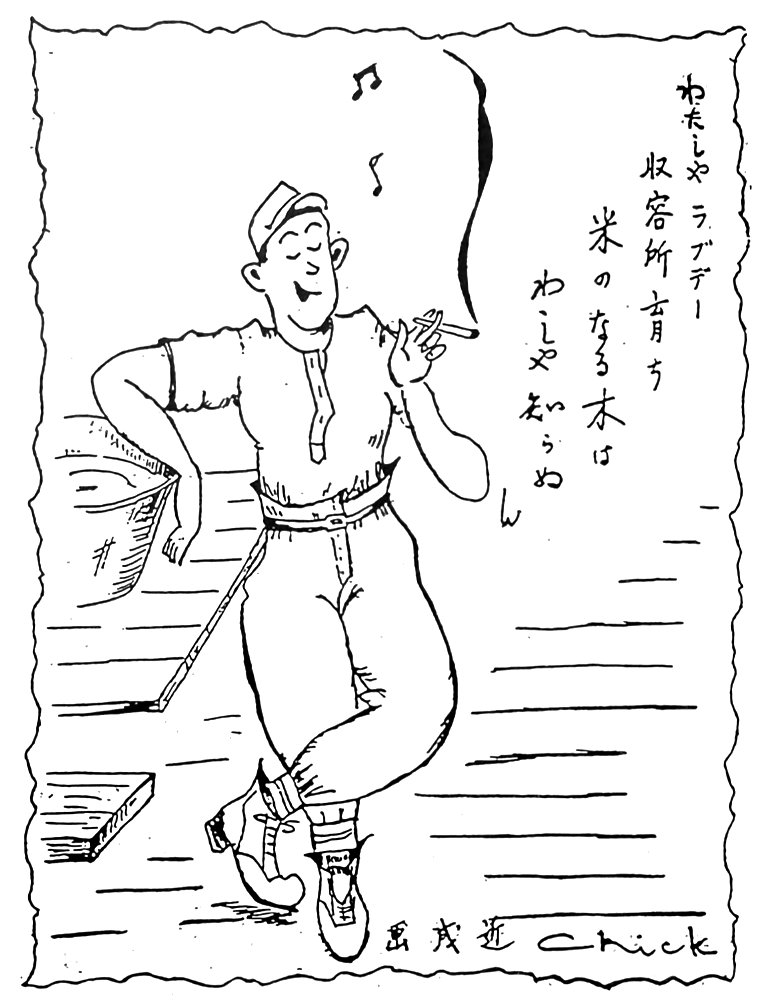
Image of illustration with Japanese text ‘I grew up in Loveday Camp I have no idea about how rice grows’ by Mr Chikanari
The Gang comprised seven Australian-born, Jimmy Chi, Jimmy Hamabata, Jack Tolsee, Patrick Ahmat, Eddie Ahmat, Sam Nakashiba and Joseph Suzuki, and one Indonesian-born, Ted Takamura. Jimmy Chi, Jack Tolsee and Patrick Ahmat confirmed that friction existed with the Japanese nationals, “because we were different to them”.100 Joe Suzuki and Sam Nakashiba had experienced the clash with the Japanese at Hay before coming to Woolenook. Sam wrote:
The Japanese at Hay resented our attitude towards their customs and beliefs and as we maintained our nationality, and our loyalty to this country, they became antagonistic towards us.101
According to the authorities’ records, an indication of the level of tension between The Gang and the Japanese nationals at Woolenook was the discovery of home-made weapons in The Gang’s tent.102 On 29 June 1944 the Japanese at Woolenook went on strike because they did not want to work with The Gang, and on 3 July they were still on strike.103 But Patrick Ahmat reflected that the ill-feeling was not so serious as camp authorities thought. He recalled:
We couldn’t show any emotion. We tried not to intimidate the Japanese. We tried to stay away from them. The Japanese from New Caledonia didn’t speak English. We were segregated from the rest and our tent was put in the AMF area. We mixed with the guards.104
Jack Tolsee confirmed this:
We were segregated because all of us weren’t really Japanese. The camp staff treated us differently. We didn’t have to wear the uniform and had a lot of freedom.105
On 26 May 1945, Woolenook Wood Camp was closed and 243 internees were transferred to 14 A and D at Loveday, while The Gang remained at Woolenook on garrison fatigues so that the site could be cleared.106 Since the final transfer of Germans to Tatura on 31 January 1945, 14A and D had been empty.107 From this date, the only internees at Loveday were Japanese.
At Loveday, friction also developed between the Formosans, including those of mixed Japanese Chinese descent, and the Japanese. The 14CD camp commandant reported to the group commandant on the situation in 14C:
There has always been ill-feeling existing between the “Half-breeds” and the Japanese, the latter treating the former in a very disdainful manner. The majority of petty fights in the Compound have been between these two sections.108
The memo referred to:
Two brothers, half bred Jap-Chinese, who, on their complaint being investigated, were found to have been ill-treated, forced to carry out fatigues inside the compound, and prevented from engaging in paid employment. These two internees were transferred to another State.109
A report of an interview with a Formosan internee, Ang Poo Hok, in 14 B, described the Formosan–Japanese relationship:
The internee claims that he is always bullied by the Japanese and encounters a great deal of “pinpricking”. His expressed hatred of the Japanese is such that he would gladly join Gen. Chiang Kai Shek’s Army or the Australian Army. Ang Poo Hok quoted several illustrations of ill treatment to show that the Japanese always took priority over the Formosans and considered themselves superior, frequently using the remark contemptuously, “You are a Formosan”. Ang Poo Hok carried in his “home made” puttees a knife of dangerous proportions with which he says he is prepared to defend himself if the occasion arises.110
According to Ang Poo Hok, the Formosans were divided into two groups, those educated in Japan and pro-Japanese, and those anti-Japanese. Some of the latter formed a Formosan Society. Ang Poo Hok was one of the leaders. Zenichiroo Satonaka and Torakatsu Takamura, born in Surabaya and Tegal respectively, confirmed the Japanese attitude towards the Formosans in 14B. They said:
The expression, “Taiwanjin no kuseni” (You are only Formosan, so how dare … ) was often heard in the camp … We didn’t speak Japanese, so we weren’t quite accepted either.111
Tatsuzoo Imaizumi described the Formosan–Japanese relationship in 14C: “Taiwanese didn’t mix with the others very much. They didn’t take part in entertainment or sports very much either.”112 In spite of the evidence of internal friction in the Japanese compounds, the compounds appeared calm to camp personnel. When asked about internal problems, Bob Margitich replied:
I was not very aware of such a problem … Let’s say there was friction which became a fight in 14C. We would go in there with a piece of paper and a pen. I was only a clerk. By the time we got there, they were all poker-faced. There was nothing wrong anywhere. I got the idea that it was the Japanese way of saving face, “we are good internees, we don’t fight, we don’t do anything”. If you went into the German or Italian sides, there would be one group on this side and one on the other swearing at each other in their own language. But if you went into 14C, everything was dead quiet. There was no way that I could read their faces. It was a bit scary …113
At Tatura also, Formosans developed factions within their own compound, one pro- and the other anti-Japanese. Sher Cheng Chuan’s family from NEI was anti-Japanese:
My family left Taiwan and went to NEI because we didn’t like the life under Japanese control. I think Taiwanese are generally free-minded, independent people. They just left the country like migrating birds southward to a warmer place without complaining or making a protest against the government … Even in the same family there were pro-Japanese and anti-Japanese. As far as I remember, the friction (in the camp) wasn’t so evident.114
According to a former intelligence officer, “there was trouble with the Formosans in all camps”. At Tatura he used information from Takejiroo Haraguchi, the Dutch sympathiser interned in Peleng, NEI, to help him deal with the troubles caused by the Formosans. Haraguchi had extensive knowledge of Taiwan and its people through working with the Japanese colonial government in Taiwan from 1919 to 1936 before moving to NEI.115 He received protection and special treatment from the Dutch government-in-exile in Sydney while in internment. He was first interned at Loveday, but was released at the request of the Dutch government in July 1942.116 According to Gotoo, the Dutch government used Haraguchi’s knowledge and information while he was at large. He stayed in the Alexander Hotel in Melbourne disguised as a Chinese named Wong Fu. However, he felt socially isolated and requested to be returned to the camp.117 He was again interned, this time at Tatura, on 9 September 1942.118
At Tatura the intelligence officer interviewed Haraguchi many times. Their talks were mostly on economic affairs and what would happen in Japan if the war was lost:
When I first interviewed him I did it in Japanese, but soon found that his English was even better than mine … I knew that what information he gave me freely, would be truthful and not trying to pull the wool over my eyes … He would keep certain information back when he felt it was going to be against the Japanese people or army … the rest of it he would give me … What I got was reasonably satisfactory. He was of the opinion that Japan would lose the war, even in 1942.119
Haraguchi was known as “anti-war” at Loveday.120 Most former internees at Tatura remembered him, saying that he was a tall, slender, intelligent-looking man, but was different. Mori said:
He wasn’t liked by the Japanese. He wasn’t with his family or anything, but was at Tatura. I thought it a bit strange. I was suspicious of him, but wasn’t sure why. He always tried to avoid us.121
Even though former internees said they did not know exactly what he was doing, they recalled children throwing stones at his hut and calling him a “spy”.122 On 15 June 1943 Mori noted that, “Mr Haraguchi is going to Melbourne to see a Dutch officer. However, the content of the meeting is unknown.”123 Haraguchi was in Melbourne from 19 to 21 June.124
According to James Sullivan, he was there to do some broadcasting through Radio Australia. Major Scurry told Sullivan that “his broadcasts were aimed at telling the Japanese of their treatment in Australia in order to reduce the pressure the Japanese were applying to Australian prisoners of war in the Malaysian area.”125 Having spent 7 years as a student in America and Germany, Haraguchi was fluent in English, German and Indonesian. He translated Japanese news broadcasts into English for the camp commandant and translated Australian news into Japanese for Japanese internees.126 On 3 January 1945, Haraguchi wrote to Dr Tromp of the Netherlands Forces Intelligence Service in Brisbane outlining his views of the progress of the war in the Pacific:
Please inform Col. Spoor and ask him shortly to delegate someone to meet me in Melbourne or elsewhere to discuss with me in the light of recent developments of the war in the South-west Pacific certain strategical problems in connection with the Netherlands Indies … (The) 25 Pounds which Col. Spoor gave me in the beginning of August last is now entirely exhausted.127
The same Japanese-speaking intelligence officer also interviewed Professor Inagaki of Melbourne University for information on a few occasions, but did not find him useful as an intelligence source.128
In the months before the Japanese surrender, Japanese internees at Loveday, particularly the younger ones, began to show signs of unrest. The 14C compound leader, Anyei Morio, wrote to a friend in Kobe, Japan. A censored portion of the letter read:
The times are becoming more and more eventful. It is terrible about Okinawa. From now on, it will be a battle of the people’s will-power. I suppose they will be able to land on the mainland. Ah, my heart is filled with fever! I pray for the victory of the Imperial Army and for the souls of the soldiers killed in battle.129
The news of the United States’ landing on Okinawa deeply agitated internees who had been born there. They were mainly from the NEI and New Caledonia, and many were in their twenties and thirties.130 On 29 March 1945, a half Japanese Chinese internee from 14C gave information to the 14C/D camp commandant about a contemplated break-out by the young internees from Okinawa in Huts 1 and 6. A report noted:
an internee of 14C Compound has deviated from the procedure of going through the Compound Leader, who rules with an iron hand and insists that every detail, no matter how small, go through him to the Camp Commandant.131
Camp authorities immediately took security precautions. The Loveday war diary recorded:
Special Security precautions were instituted throughout the area in consequence of a report that younger Japanese in 14C contemplated a suicidal breakout, in consequence of the American Forces invading and bombarding islands near Japan.132
All non-combatant personnel were armed and given lessons in the handling of automatic weapons, and the compound guard was strengthened.133 There had been two POW breakouts, one at Featherstone, New Zealand, in March 1943, the other at Cowra in August 1944. AMF guards at all internment camps were informed of these incidents.134 The camp authorities feared a similar occurrence at Loveday. The group commandant at Loveday noted:
It is known that the younger Japanese internees have the characteristic fanatical ideas of dying for their Emperor when adverse events take place in regard to their “National Honour” (so-called). This H.Q. has also been informed by a senior officer that Japanese POWs held in other areas intend to commit “honourable Hara-Kiri” if and when Japan is defeated. To do this they will try to attack their guards by attempting to break out of their compounds.135
The camp staff also observed unrest among the younger internees in 14B. The war diary of 21 May 1945 recorded:
An internee in 14B stated that when America captures Okinawa the Japs who came from there will either commit suicide by hanging, or if there are enough of them, they may try to make a break. Extra precautions being taken.136
This informant was also Chinese.137 The camp authorities organised special exercises in the possible event of an attempted mass escape.138 The Adelaide News reported on 25 April 1945:
“Guards on Alert at Jap Camp”
Guards at a S.A. internment camp are making special plans to forestall any possible mass suicide uprising by Jap prisoners. Suicidal uprisings have been staged by Japanese prisoners of war in other parts of Australia and in New Zealand and authorities have found cause to suspect the attitude of prisoners at a South Australian camp. In towns near this camp it is known that special precautions have been taken to counter any attempt to break out of the compounds. Residents in the neighbourhood have remarked on the increased use of a river district rifle range by troops from the camp. Rifle and machine gun firing practices have been conducted.139
On 7 June 1945 the group commandant decided to hold a sports meeting between B and C Compounds to occupy the minds of the younger internees. He reported on 12 June:
The Japanese internees … have for the first time been permitted to hold a combined sports meeting. This privilege was granted in order that the reaction particularly of the younger internees might be assessed. In doing so it was considered that the concession would contribute towards greater contentment in the Compounds, and give the younger Japanese who constitute a small number only, something to practice for, think of and talk about … 140
On 24 June the first baseball match was held in 14D Compound between 14B and 14C. Approximately 1,000 Japanese supporters attended, and 14C team won.141 Although the unrest among the young internees did not worsen, security measures were maintained. Another match was held in the following month which were well-received and attended.142 No breakout was ever attempted.
On 6 August 1945 the atomic bomb was dropped on Hiroshima. Three days later Nagasaki was also bombed. The Japanese internees read of the devastation caused by the bombings in local newspapers but could not guess at the nature of the weapon.143 On 15 August, the Japanese internees were told of the Japanese surrender. The administration of all three camps handled the day with extreme caution. The camp commandants first called in each compound leader to announce the news, then asked them to tell their fellow internees. Loveday’s war diary recorded that compound leaders were told:
[that] the war had ended and that Japan had surrendered, that the government and the Australian Army would continue to treat them as usual, that they were expected to co-operate with the Camp Commandants and that they were to be held responsible that no untoward incidents took place in the Compounds, that there was to be no friction between the internees … and that they were to go back to the Compounds and inform the men of these facts …144
“It had never been so quiet before,” recalled Bob Margitich.145 On 16 August the Emperor’s surrender speech was broadcast at Loveday and Tatura.
We have ordered our Government to communicate to the Governments of the United States, Great Britain, China, and the Soviet Union that our Empire accepts the provisions of their Joint Declaration … the war situation has developed not necessarily to Japan’s advantage, while the general trends of the world have all turned against her interest. Moreover, the enemy has begun to employ a new and most cruel bomb, the power of which to do damage is, indeed, incalculable, taking the toll of many innocent lives. Should we continue to fight, it not only would result in the ultimate collapse and obliteration of the Japanese nation, but also it would lead to the total extinction of human civilization …
The hardship and sufferings to which our nation is to be subjected hereafter will be certainly great. We are keenly aware of the innermost feelings of all of you, our subjects. However, it is according to the dictates of time and fate that we have resolved to pave the way for a grand peace for all the generations to come by enduring the unendurable and suffering what is insufferable …146
Many former internees recalled that the speech was not very clear due to static and the Emperor’s high-pitched voice, and because the Emperor’s language was almost incomprehensible to ordinary Japanese.147 A German news correspondent who witnessed public reaction to the Emperor’s surrender speech in Tokyo said:
And then came this voice which had never been known by the people, very strange, very slow and, something more extraordinary, speaking a language that these people did not understand. Because since over a thousand years or more the Emperor had a language of his own. Some guessed what it was, that it was not an appeal to fight.148
Sumie Seo Mishima, a resident in Japan at the time, wrote:
Many of us had not been sure whether the Emperor had a human voice. He was divine, superman, merciful and mighty, so we had been told. But gentle and plaintive was the voice that came on the air … The audience was perfectly quiet.149
Tatsuzoo Imaizumi observed the reaction in his compound at Loveday:
After hearing the Japanese Emperor’s proclamation over the radio of Japan’s surrender to the Allied governments many of them were dumbfounded, a few of them were crying openly without shame in utter disbelief of what they had heard, some were muttering away to themselves, but to say the truth the majority of the internees including myself were overjoyed to be informed that the war had ended at last and peace had returned to this world.150
According to intelligence reports from Loveday, older internees did not believe that Japan had lost the war. One was quoted as saying that:
Japan had won the war. It was not possible for the nation to be beaten after she had conquered so often and after she had, by the admission of even the Australian press (which was normally 90% lies), occupied nearly all of the Pacific. He knew the truth, he said because he knew Japanese.151
Camp authorities had observed a similar reaction among Italian internees at Loveday when Italy in September 1943. Although the majority accepted it and were relieved, the Fascist element thought it was a false report.152 Many of the old Japanese at Loveday, especially those from New Caledonia, tended to disbelieve the news because they had heard incorrect reports during previous wars.153 Those who accepted the news felt intimidated. Imaizumi recalled:
There were really patriotic people in the compound who got very aggressive towards people like myself … They said they would inform the Kempei (Secret Military Police) in Japan that we were disloyal.154
The compound leader of 14C was threatened physically by an internee from the patriotic sector in the compound and asked the administration for protection.155 Members of both internees’ committees at Loveday believed the news and were concerned. They tried various means to avoid “incidents between internees” in the compounds as they were told the news by the camp commandant. It was decided not to say that Japan had lost the war, but instead that the war was suspended.156
On the day following VP Day, the camp authorities at Hay took precautions against trouble from Japanese POWs in Camps 7 and 8. They doubled the sentries on weapon posts, but no incident was reported.157 The PWJMs in Camp 6 reacted to the surrender with silence. Chinenji Kaino said:
The news didn’t really register. Instead we thought Japan had won the war and so we celebrated the occasion … In a local newspaper, there was a cartoon of MacArthur squeezing a glass bottle with the Emperor inside. We thought it was really bad propaganda.158
Another PWJM wrote to a friend at Loveday:
There are a lot of rumours which are as false as the news in the papers. However, we should not be pessimistic and should have faith in the spirit of the Japanese.159
Many were not able to show their feelings. Kaino added:
I think many of us actually did believe deep in our hearts, that Japan had lost the war. But we were all afraid of the reactions of others, particularly the militaristic ones … we couldn’t say anything unpatriotic.160
At Tatura the patriotic groups in Compound C and D did not believe the news. Taishiroo Mori thought it was fabricated:
We didn’t believe it. Even when we saw photos of the one-legged shrine gate in Nagasaki and the dome in Hiroshima where atomic bombs had been dropped. We thought it was all propaganda. They were pretty realistic, we thought then.161
In Compound A and B, the end of the war was a happy event. Albert Ueno said: “It was a relief. The war was finally over and most of us were happy. There were some who couldn’t accept the news.”162 According to Masuko Murakami, Professor Inagaki tried to convince those in Compound B that the news was false.163 Masuko said:
We heard about the bombings of Hiroshima and Nagasaki and all that, but still we didn’t believe it … it was not that we didn’t believe it, but that we didn’t want to.164
Some Australian-born Japanese expressed joy at the news:
We were so glad that the war finally ended. We shouted by saying, “They lost the war. Hooray!” The Japanese didn’t like it, I am sure. Father was, of course, very annoyed with us.165
Harry Liang, a Formosan internee at Tatura, was also happy with the news. On 15 August 1946 he wrote to Sullivan:
I write to you particularly today, the first anniversary day of the surrender of the cruel Japs, and the dramatic crash of Fascism in this world. Indeed it is a day to remember. Thinking back a year ago today, before breakfast I listened to the news … in a happiest mood. The surrender of the Japs indeed was my happiest moment.166
According to the camp authorities, internees in 14B at Loveday had mixed reactions. Those who were more educated generally accepted Japan’s defeat and were pleased that their internment would be over. The older, less-educated internees believed that Japan had won the war and looked forward to their return to Japan. The Australian-born were sure of the outcome of the war, while the younger group of internees from NEI appeared to be “incapable of worrying about anything”.167 It was noted that Oyama Hashi, the laundryman from Sydney, “deplored the stupidity of Japanese leaders dragging the country into a war against the most powerful nations in the world, and dwelt at some length on the unfortunate position of victims such as himself”.168
According to an intelligence report of 5 February 1946, most internees at Loveday did not believe accounts of atrocities committed by the Japanese, but those who had more education appeared to be puzzled by the reports.169 Nagano, secretary of 14B internees committee, was quoted as saying:
… in all nations there were bad individuals and that he could not understand the reports as Japanese in culture and honour were above committing such things.170
This could be explained by the isolation within the camps and the lack of war news or means to assess what little news they did receive. Joe Murakami said:
During the period we were in camp we were not conscious of any first-hand animosity except as conveyed by the local newspapers which were handed to us after being censored by the military. We were a little colony on our own, with the barbed wire barricades serving as a buffer against the reality that existed on the outside.171
One PWJM at Hay wrote:
for the last four years we do not know what has happened to the outside world … However, we expect to be released soon and we will be able to see our rapidly progressing Japan again …172
Senshooha [lit. a faction which believed in a Japanese victory] was not unique to Japanese internees in Australia. It also occurred in Japanese communities or internment camps in other parts of the world.173 According to Imano and Fujisaki, Senshooha were generally early settlers who were unaware of what was happening in the world and were over-confident of Japan’s military power. They were proud of the Yamato [traditional Japanese] spirit as exemplified by Japan’s victories in previous wars. This surfaced as a reaction to the news of Japanese defeat.174 Okada, a local internee from Queensland, was quoted by an intelligence report of 5 February 1946 as saying that: “overseas internees were impossible to live with. Their faith in their country was implicit and they believed nothing of the news in the press. He had involved himself in trouble with them through trying to point out that “black was not white”.175
Tension between the Formosans and the Japanese worsened following changes in the attitude of some Formosans after Japan’s surrender. On 9 November 1945 the 14B camp commandant at Loveday reported:
There has always been tension in the compounds between Japanese and Formosans, Japanese always treating the Formosans as being of very low caste and not fit to mix socially with pure Japanese. Formosans have never been allowed to take an active part in either the social life or the administration of the compound. This tension has become more strained in recent days, since the Formosans, in a letter to the Chinese Consul, requested recognition as Chinese subjects.176
One cause of the worsening friction was relief money. The Japanese taunted Formosans with the fact that while Japan was at war, some Formosans accepted Japanese government money, but after the defeat of Japan they declared themselves not loyal to Japan.177 Resentment was particularly strong among the circle of patriotic Japanese in 14B where the majority of Formosans were held. Of the 143 Formosans at Loveday, only 25 were held in 14C. Seventy-five Formosans had been receiving an allowance from the Japanese government.178 The end of Japan’s 50-year control of Formosa came with Japan’s formal surrender on 2 September 1945.179 Formosans regained their Chinese citizenship once Formosa was returned to China. The consul for the Republic of China in Melbourne, L.M. Wang, having had correspondence with the Formosans at Loveday, became aware of this situation and told Army Headquarters:
Formosans wish to be separated from Japanese internees and repatriated to Formosa. Formosans who pledge their loyalty to China feel that the separation is advisable to prevent clashes among the internees.180
The compound leader of 14B wrote to the camp commandant:
As we might suppose you already know, most of the Formosans in our compound have brought forward to you recently their wish to be shifted to the other camp … I can not understand why they are so rash as to start an action in this way. Anyhow, as a result of their egotistic, treacherous and ungrateful attitude, I fear that there may occur a conflict … between those category of people and other Japanese in the camp … I will try my best to avoid every trouble … the best step to take is to separate these Formosans, in order to assure the peace in our camp.181
The group commandant, however, decided not to take any special action. He reported to Adelaide Headquarters saying “this attitude of threat of violence is an old game which was tried by the Germans many times in Number 10 Compound, but the minorities were never molested.”182
At Tatura, however, Formosans with Japanese sympathies were moved to B, C and D Compounds, while A was left to Formosans who claimed loyalty to China.183 In January 1946 the Formosan compound leader at Tatura, Tan Tiaw Lin, expressed his concern on behalf of other Formosans who wished to return to Formosa. He wrote to the Chinese Consul:
We had sent you two letters … which we thought they had reached you long ago … there were one hundred and six members Formosans who would receive the Japanese relief fund had been transferred to another as being regarded to be loyal to Japan. The rest of us one hundred and fifty-eight members are purely loyal to our country … we are in great illusion whether we are to be sent back together with the repatriated Japanese or to be repatriated separately to Formosa.184
For some the end of the war marked the end of separation from their families. They looked forward to returning to their homes in Japan or elsewhere. Paradoxically, the end to the established routines of camp life meant for others a return to insecurity. Japan had lost the war and as “Japanese” they were unsure about what would happen to them.
Notes
- Tatsuzoo Imaizumi, letter, 19 May 1985. ↩
- Ibid. ↩
- Shigeru Nakabayashi, Tokyo, 22 Dec. 1986. ↩
- Peggy Carlie, Derby, 26 Aug. 1986. ↩
- The late Masuko Murakami, Darwin, 29 Aug. 1986. ↩
- Ibid. ↩
- Peggy Carlie, Derby, 26 Aug. 1986. ↩
- Alf Shiosaki, Perth, 21 Aug. 1986. ↩
- AP 589, SS 1067, 27 Nov. 1942. ↩
- Tatsuzoo Imaizumi, letter, 16 Dec. 1985. ↩
- AWM 52, 8/7/42, 7 Dec. 1944. ↩
- Mori’s Diary, 8 Dec. 1942. ↩
- Peggy Carlie, Derby, 26 Aug. 1986. ↩
- Jessie Banno, Tokyo, 10 Sept. 1988. ↩
- The late Ethel Punshon, Melbourne, 30 Nov. 1985. ↩
- Zenichiroo Satonaka, Kawasaki, 2 Feb. 1987. ↩
- Bob Margitich, Adelaide, 28 Oct. 1984. ↩
- Ishii, p. 186, [J]. ↩
- Bob Margitich, Adelaide, 28 Oct. 1984. According to the German Compound Leader, the Germans lost interest in gardens and other projects which they had been creating in Number 10 Camp when they were transferred to Number 14D. The transfer was considered to be a severe collective punishment. AP 613/ 1, 90/1/238, letter written by Graf von Mensdorff, 4 Jan. 1944. ↩
- Shigeru Nakabayashi, Tokyo, 8 Jan. 1987. ↩
- Shinji Kondo, Kawasaki, 25 Jan. 1987 and Chinenji Kaino, Wakayama, 26 Jan. 1987. ↩
- Bert Whitmore, Barmera, 8 Sept. 1984. ↩
- Harold White, 24 Jun. 1986. ↩
- Chinenji Kaino, Wakayama, 26 Jan. 1987. ↩
- Mari Kai, Yokohama, 11 Jan. 1987. ↩
- James Sullivan, Melbourne, letter, 25 Oct. 1991. ↩
- Shigeru Nakabayashi, 8 Jan. 1987. ↩
- Jim Sullivan, Melbourne, 25 Oct. 1991. ↩
- Peggy Carlie, 26 Aug. 1986. ↩
- Jim Sullivan, Melbourne, letter, 25 Oct. 1991. ↩
- Shigeru Nakabayashi, 8 Jan. 1987. ↩
- Chinenji Kaino, Wakayama, 26 Jan. 1987. ↩
- Jimmy Chi, Broome, 25 Aug. 1986. ↩
- Chinenji Kaino, 26 Jan. 1987. ↩
- Shigeru Nakabayashi, 8 Jan. 1987. ↩
- Taishiro Mori, Saga, Japan, 17 Jan. 1987; Joe Murakami, Yokohama, 25 Jan. 1987 and other former Tatura internees. ↩
- Torakatsu Takamura and Zenichiro Satonaka, Yokohama, 1 Feb. 1987; Chinenji Kaino, 27 Jan. 1987; Taishiro Mori, 17 Jan. 1987. ↩
- A film of the Loveday Internment Camps made by George Bolton, 3 Nov. 1945, held by George Bolton Jnr., Adelaide. ↩
- Torakatsu Takamura and Zenichiro Satonaka, Yokohama, 1 Feb. 1987. ↩
- Ibid. ↩
- Ibid., [J]. ↩
- Invitation, 16 Aug. 1944, in the possession of Mick Beckwith, Hay. ↩
- Ibid. ↩
- Chinenji Kaino, 26 Jan. 1987. ↩
- Harold White, letter, Dee Why, 24 Jun. 1986. ↩
- Taishiro Mori, Saga, 17 Jan. 1987. ↩
- Peggy Carlie, Derby, 26 Aug. 1986. ↩
- Jim Sullivan, Melbourne, letter, 25 Oct. 1991. ↩
- Ibid. ↩
- The Circus Report, USA, 8 Oct. 1979. ↩
- Jim Sullivan, Melbourne, letter, 25 Oct. 1991. ↩
- Peggy Carlie, 26 Aug. 1986. ↩
- Harumi Ahloy née Yamashita, Thursday Island, 12 Jul. 1992. ↩
- Don Vallance, Brisbane. ↩
- AP 413/1, 90/1/205, 7 Feb. 1944 ↩
- Imaizumi, Osaka, 29 Jan. 1987; Taishiro Mori, Saga, 17 Jan. 1987; Jessie Banno, Tokyo, 10 Sept. 1988. ↩
- AWM 54, 780/1/6, p. 49. ↩
- Chinenji Kaino, Wakayama, Japan, 26 Jan. 1987. ↩
- A.7.0.0, 9/11/1/10/2, 6 Mar. 1944. ↩
- AWM 54, 780/1/6, pp. 50-51. ↩
- AP613/1, 90/1/125, 22 Sept. 1943. ↩
- Evelyn Suzuki née Yamashita, Sydney, 22 Aug. 1987. ↩
- Taishiro Mori, Saga, 17 Jan. 1987. ↩
- Ching Quan She, Gaosheng, Taiwan, 5 Dec. 1986. ↩
- Alice Pao, Rushworth, 5 Jan. 1993. ↩
- AWM 54, 780/1/6, p.49. ↩
- Jim Sullivan, 25 Oct. 1991. ↩
- Taishiro Mori, Saga, 17 Jan. 1987. ↩
- Ibid. ↩
- Original in Japanese by Yakamochi Otomo, verse 4094, published in English, The Manyoshu, Columbia University Press, New York, 1965, p. 151. ↩
- Mari Kai, Yokohama, 11 Jan. 1987, [J]. ↩
- Jim Sullivan, Melbourne, letter, 25 Oct. 1991. ↩
- Taishiro Mori, 17 Jan. 1987. ↩
- Translation by the author. ↩
- Translation by the author. ↩
- Taishiro Mori, 17 Jan. 1987. ↩
- Monbusho [Ministry of Education], “Kokutai no Hongi” [The Fundamentals of Our National Polity], Tokyo, 1939, p. 13 quoted in Tsurumi, K., Social Changes and the Individual: Japan Before and After Defeat in World War II, Princeton University Press, 1970, p. 107. ↩
- Mori’s Diary, 1 Apr. 1944. ↩
- Peggie Carlie née Shiosaki, Derby, 26 Aug. 1986. ↩
- The late Saburo Kanegae, Broome, 25 Aug. 1986. ↩
- Mari Kai, Yokohama, 11 Jan. 1987. ↩
- Takeichi Minami, Wakayama, Japan, 27 Jan. 1987. ↩
- Yoko Tsushima, Kawasaki, 15 Jan. 1987. ↩
- Yuri Murayama, Tokyo, 30 Jan. 1987; Takeichi Minami, Wakayama, 27 Jan. 1987 and Evelyn Suzuki, Sydney, 22 Aug. 1987. ↩
- Yuri Murayama, Tokyo, 30 Jan. 1987. ↩
- Evelyn Suzuki, Sydney, 7 May 1992. ↩
- Mori’s Diary, 16 May 1942. ↩
- Ibid. ↩
- MP 1103, Series 1, Box 6. ↩
- Jim Sullivan, 25 Oct. 1991. ↩
- Name withheld, 11 Oct. 1984. ↩
- Masu Tsutsumi, Nagasaki, 17 Jan. 1987. ↩
- Joe Murakami, Yokohama, 16 July 1988. ↩
- Albert Ueno, Yokohama, 14 Jan. 1987. ↩
- Jessie Banno, Tokyo, 15 Jan. 1987. ↩
- James Sullivan, Melbourne, 1 Dec. 1985. ↩
- Name withheld, Brisbane, 25 Aug. 1987. ↩
- Ibid. ↩
- Guthrie Hutchinson, Adelaide, 3 Oct. 1984. ↩
- Patrick Ahmat, 25 Aug. 1986 and Jack Truan (Tolsee), 22 May 1993. ↩
- D 1901, N 3301. ↩
- Gathrie Hutchinson, 3 Oct. 1984. ↩
- AWM 52, 8/7/42, 3 July 1944. ↩
- Patrick Ahmat, Perth, 22 Aug. 1986. ↩
- Jack Truan, Palmers Island, NSW, 22 May 1993. ↩
- AWM 52, 8/7/42, 26 May 1945. ↩
- Internment in S.A., p. 8. ↩
- AP 613/1, 162/1/64, 1 Apr. 1945. ↩
- Ibid. ↩
- D 1901, A 3243, 9 Aug. 1943. ↩
- Zenichiroo Satonaka and Torakatsu Takamura, Kawasaki, 2 Feb. 1987. ↩
- Tatsuzo Imaizumi, Osaka, 29 Jan. 1987. ↩
- Bob Margitich, Adelaide, 28 Oct. 1984. ↩
- Sher Cheng Chuan, Gaosheng, Taiwan, 5 Dec. 1986. ↩
- Gotoo, pp. 253–254. ↩
- Ibid., p. 220. ↩
- Gotoo, pp. 220–221. ↩
- MP 1103, Series 1, Box 6. ↩
- Former intelligence officer, name withheld, 9 Feb. 1990. ↩
- Etsuroo Chikanari and Sakae Masuda, Koobe, 12 Jan. 1992. ↩
- Taishiroo Mori, Saga, 17 Jan. 1987. ↩
- Mari Kai, Yokohama, 11 Jan. 1987. ↩
- Mori’s Diary, 15 June 1943. ↩
- MP 1103, Series 1, Box 6. ↩
- James Sullivan, letter, Melbourne, 13 Feb. 1990. ↩
- Gotoo, p. 230. ↩
- A 1066, 45/1/11/2, 3 Jan. 1945. ↩
- Former intelligence officer, name withheld, letter, 9 Feb. 1990. ↩
- AP 613/1, 162/1/64, 13 Apr. 1945. ↩
- AP 613/1, 162/1/64, no date. ↩
- Ibid., 1 Apr. 1945. ↩
- AWM 52, 8/7/42, 29 Mar. 1945. ↩
- AP 613/1, 162/1/64, 1 Apr. 1945. ↩
- AP 613/1, 90/1/46, 15 Mar. 1943. ↩
- AP 613/1, 162/1/64, 1 Apr. 1945. ↩
- AWM 52, 8/7/42, 21 May 1945. ↩
- Ibid. ↩
- Ibid. Exercises were conducted on 20 Apr., 1 and 23 May, 1945. ↩
- Adelaide News, 25 Apr. 1945. ↩
- AP 613/1, 162/1/64, 12 June 1945. ↩
- AWM 52, 8/7/42, 24 June 1945. ↩
- AWM 52, 8/7/42, 8 July 1945. ↩
- Masuko Murakami, 29 Aug. 1986; Taishiro Mori, 17 Jan. 1987; Tatsuzo Imaizumi, 23 Jan. 1987. ↩
- AWM 52, 8/7/20, 15 Aug. 1945. ↩
- Bob Margitich, Adelaide, 28 Oct. 1984. ↩
- Kosaka, Masataka, A History of Postwar Japan, Tokyo, 1982, p. 11. ↩
- Ibid., Osaka, 23 Jan. 1987. ↩
- Robert Guillan, a news correspondent for the Havas News Agency in Tokyo, 1938–1946, who appeared in Hirohito, a BBC documentary, 15 Jan. 1989. ↩
- Seo Mishima, Sumie, The Broader Way: A Woman’s Life in the New Japan, Connecticut, 1971, pp. 56-57. ↩
- Tatsuzo Imaizumi, letter, 25 Sept. 1985. ↩
- AP 719/3, S112667, 29 Jan. 1946. ↩
- AP 613/5, 90/1/237, 10 Sept. 1943. ↩
- Koike, Miyakatsu, p.152. ↩
- Tatsuzo Imaizumi, Osaka, 23 Jan. 1987. ↩
- Ibid. ↩
- Koike, p.152. ↩
- AWM 52, 8/7/20, 16 Aug. 1945. ↩
- Chinenji Kaino, Wakayama, 27 Jan. 1987. ↩
- AWM 52, 8/7/20, 1–8 Dec. 1945. ↩
- Chinenji Kaino, Wakayama, 27 Jan. 1987. ↩
- Taishiro Mori, Saga, 17 Jan. 1987. ↩
- The late Albert Ueno, Yokohama, 14 Jan. 1987. ↩
- The late Masuko Murakami, Darwin, 29 Aug. 1986. ↩
- Ibid. ↩
- Name withheld, Brisbane, 29 Aug. 1987. ↩
- Harry Liang, letter, Taipei, 15 Aug. 1946. ↩
- AP 719/3, SA12667, Loveday Intelligence Report No. 156, 5 Feb. 1946 ↩
- AP 719/3, SA 12667, 29 Jan. 1946. ↩
- AP 719/3, SA 12667, 5 Feb. 1946. ↩
- Ibid. ↩
- Murakami, 16 Jul. 1988. ↩
- AWM 52, 8/7/20, 3 Nov. 1945. ↩
- See Imano and Fujisaki, Iminshi, Vol. 1, pp. 166–182 and pp. 258–263; and Vol. 3, p. 303. Senshooha was common among Japanese communities in South America and Hawaiian Japanese interned on mainland United States. ↩
- Imano and Fujisaki, Vol. 1, p. 166 and Vol. 3, p. 303. ↩
- AP 719/3, SA 12667, 5 Feb. 1946. ↩
- AP 613/1, 90/1/146, 9 Nov. 1945. ↩
- Ibid. ↩
- Ibid. ↩
- Inoue, K., Nihon no Rekishi, Iwanami, Tokyo, 1986, Vol. 3., p. 210. ↩
- MP 742/1, 255/12/174, 26 Oct. 1945. ↩
- Ibid., 27 Nov. 1945. ↩
- Ibid. ↩
- AWM 53, 8/7/43, 16 Dec. 1945. ↩
- Ibid., 12 Jan. 1946. ↩