
Chapter 6: Camp Organisation
A postwar report listed six requirements for siting internment camps:
- The area should be as flat as possible but with sufficient fall to provide surface drainage.
- Sandy soil should be avoided as it facilitates tunnelling.
- There should be sufficient area to space separate camps at least 500 yards apart.
- The area should be well away from the seaboard but centrally located.
- Good water supply should be available.
- Camps should not be erected in thickly populated areas.1
Tatura is 180 kilometres north of Melbourne in the Western Goulburn Valley. The countryside is not arid and much of the district had been subdivided after 1921 for development as irrigated orchards following the completion of the Waranga Reservoir.2 The Victorian internment camps were concentrated in this area. Four internment camps, Numbers 1, 2, 3 and 4, were between Tatura and Rushworth. Number 1 contained mainly German internees. Number 2, a smaller camp, contained mainly Australians with Nazi sympathies. Numbers 3 and 4 contained women and family groups – Number 3 Germans and Italians, and Number 4 Japanese. These family camps were located nearer to Rushworth and were often referred to as the Rushworth Internment Camps.
The Hay Internment Camps were located in almost treeless, semi-arid grazing country 750 kilometres west of Sydney. They were immediately adjacent to Hay, which had a population of about 3,000.3 The Murrumbidgee River ran nearby and was the major water source for the camps. There were three camps at Hay – Numbers 6, 7 and 8. Numbers 7 and 8 housed German and Italian refugee internees who were transferred from the United Kingdom. Number 6 held Japanese.
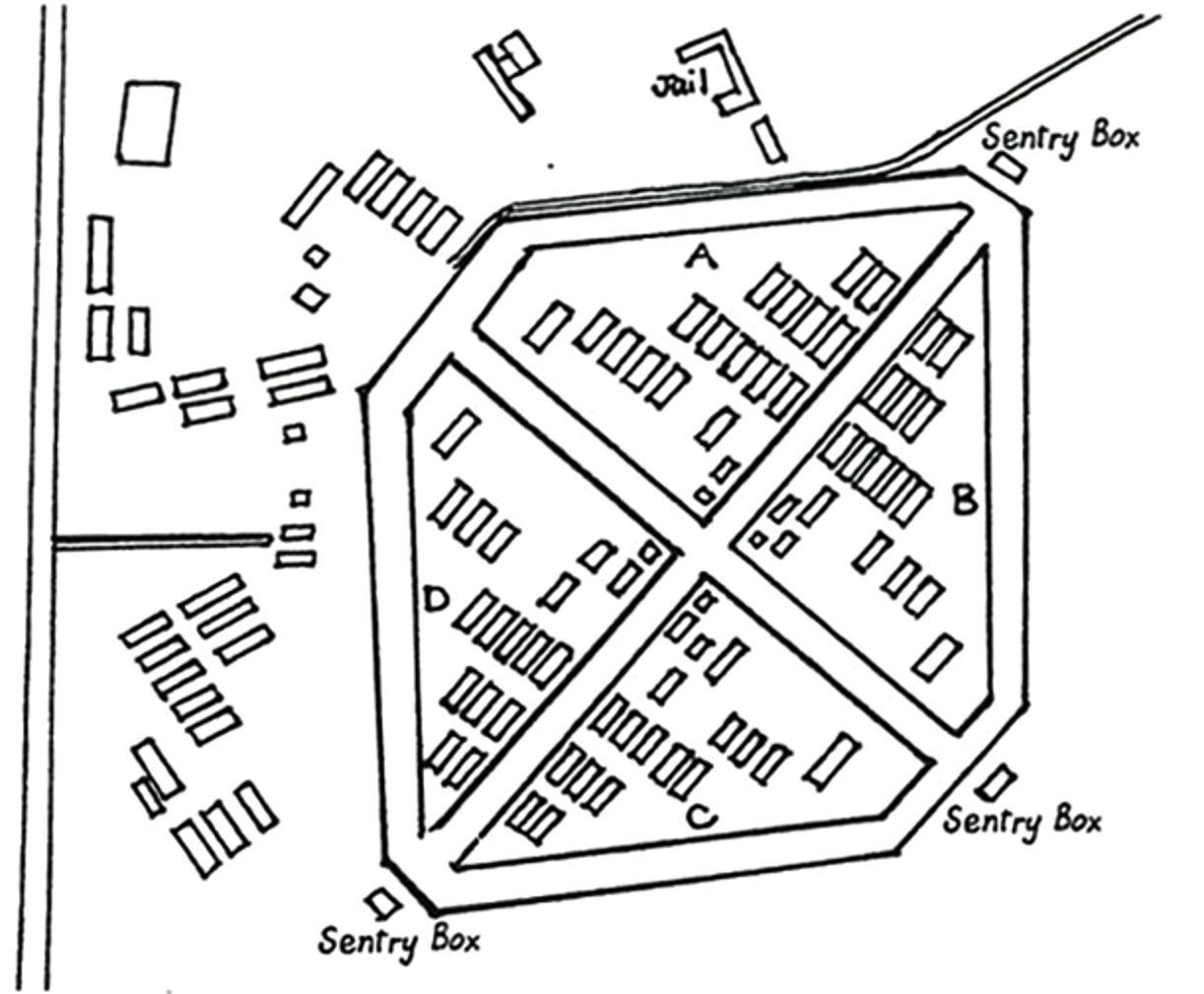
Tatura Internment Camp No. 4
(Source: redrawn from an aerial photo by the author)
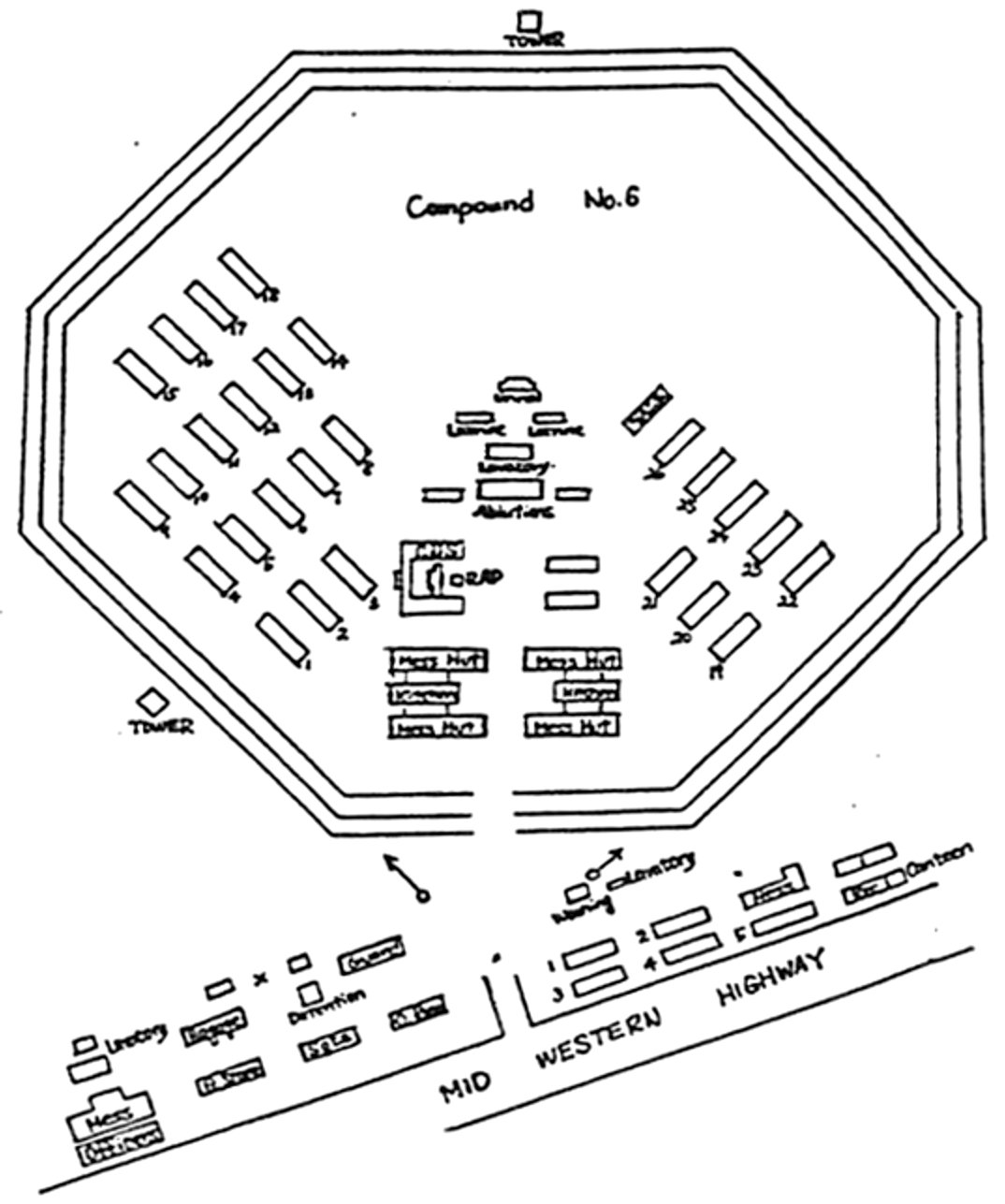
Hay Internment Camp No. 6
(Courtesy of Mick Beckwith)
Loveday is in semi-arid country near Barmera in the centre of the Riverland district of South Australia, approximately 200 kilometres by road from Adelaide. Only part of the district was settled and the site had fair soil. A reticulated water supply had been installed in the expectation that the land would be used for soldier settlement.4 Three camps were built there – Numbers 9, 10 and 14. Construction of Numbers 9 and 10 was commenced in August 1940.5 Number 9 housed local Italian internees and Number 10 housed overseas German and Italian internees. Number 14 was constructed later to deal with increasing numbers. It was being built when Japan entered the war in December 1941. Number 14 held internees of all the Axis nationalities – Italians, Germans and Japanese.6
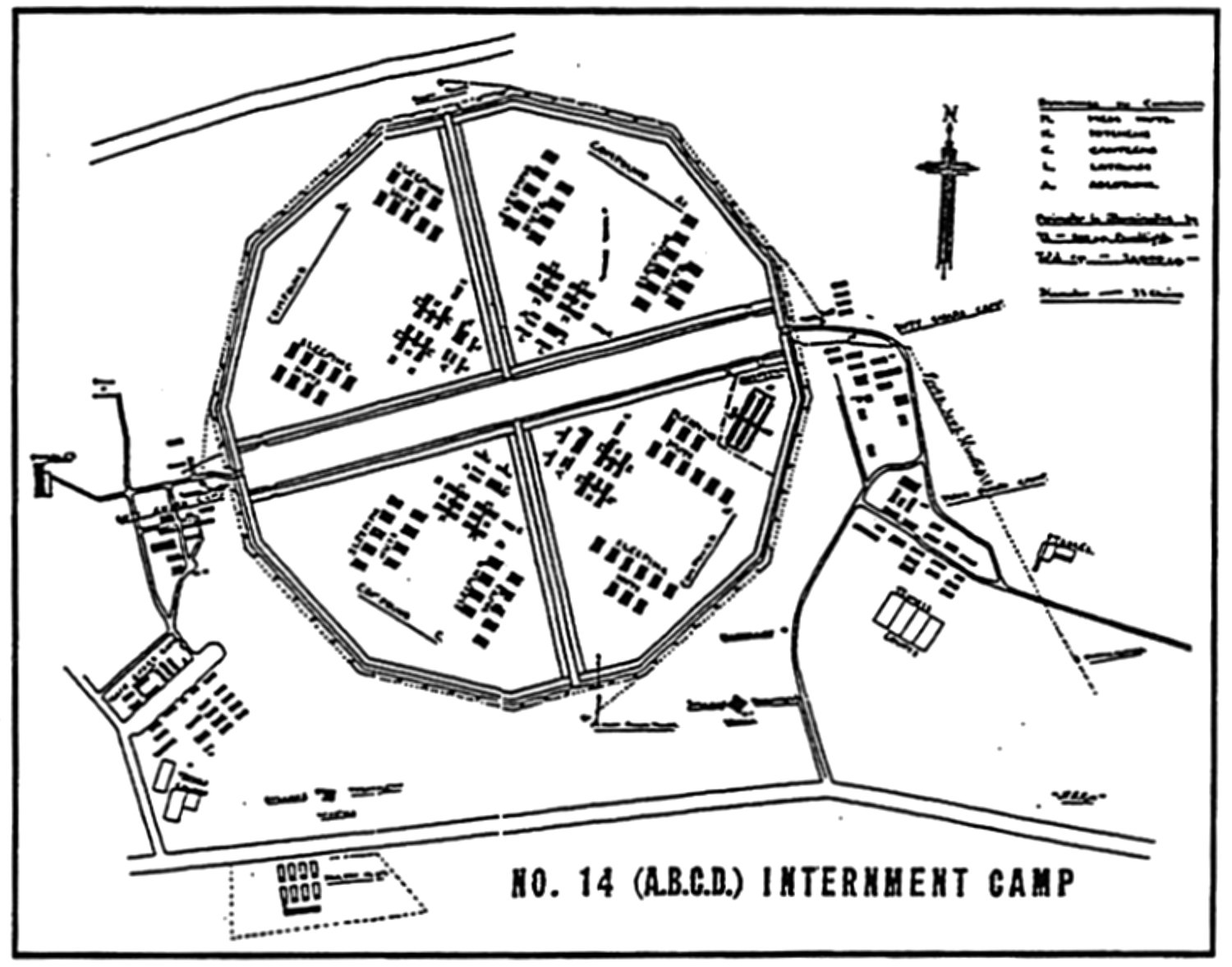
Loveday Internment Camp No. 14
(Source: Internment in South Australia, Appendix, 1946)
The arrival of camp personnel in the quiet townships of Tatura, Hay and Barmera had a major influence on the social and economic life of local residents. The first commandant of the Tatura Camp Group was Lieutenant Colonel W.T. Tackaberry (1939–1942).7 Tackaberry had retired from the Army in 1936 and was 60 when he came out of retirement to take charge of internment camps in Victoria.8 After him a series of officers held the position at Tatura, ending with Lieutenant Colonel J.W. Rhoden in 1945.9 Over 700 officers and other ranks guarded the four camps, each of which could hold 1,000 prisoners.10 Camp personnel also held fortnightly dances, concerts and sporting events, and provided a band. All this “entailed an organisation comparable to that of a thriving town”.11 Lieutenant Colonel C.S. Thane was group commandant at Hay (1940–1944).12 About 800 officers and other ranks guarded 3,000 prisoners. In the words of Mick Beckwith, a local researcher, the three camps were “a great thing for Hay at the time”.13 The Loveday Internment Group became a temporary township and provided various services to the 1,374 officers and other ranks guarding 6,756 internees at the peak time in 1943.14 Lieutenant Colonel E.T. Dean was group commandant (1940–1946). Loveday Hall, erected by internees, was the entertainment centre and venue for many functions, including fortnightly dances and performances by the camp orchestra.15 Many of the women in the district attended the dance nights. Myra Tunbridge, now a resident of Adelaide, was 17 in 1942:
A bus used to wait for us in town (Barmera) after work on dance nights. Many of my friends went too. We looked forward to those nights. There wasn’t much else in town. It was a real small town.16
The internment camps were built by Army engineers according to standard plans for housing soldiers.17 They were basically Army camps and were designed to last only a few years. They consisted of galvanised iron and timber buildings surrounded by a triple barbed-wire perimeter of dodecagonal shape or other polygonal design. Number 4 Camp at Tatura was square in shape. The perimeters were guarded by four watchtowers equipped with machine guns and searchlights. Number 4 Camp at Tatura and Number 14 at Loveday were divided into four compounds designated A, B, C and D, while Number 6 at Hay was a single compound camp. Each compound contained an appropriate number of sleeping huts (usually 36 feet by 60 feet), mess halls, kitchens, laundry rooms, latrines and ablution blocks, and large recreation huts.18 At Loveday each compound had 18 sleeping huts, each housing 56 men,19 while at Hay there were 26 huts, holding an average of 30 men each.20 At Tatura each compound consisted of 10 large huts – 12 rooms to each and two large mess halls, one large kitchen, male and female wash houses, six baths and a recreation hall.21 The sleeping quarters were partitioned as required to accommodate families, and playing areas for the children and necessary school accommodation were provided.22
When internees arrived at a camp, a nominal roll was made, and internees were photographed and had their fingerprints taken. Local internees were given internee identification numbers at the staging camp where they were first detained. The numbers were prefixed with letters indicating their nationality and the area where they had been arrested. QJ was a Japanese internee from Queensland, WJ from Western Australia, DJ from Darwin, NJ from New South Wales and VJ from Victoria. Overseas internees were coded IJ from NEI, CJ from New Caledonia, HJ from the New Hebrides, NZJ from New Zealand and P from the Pacific Islands. The identification numbers for females included an F after the area letter.23 Overseas internees were normally given identification numbers before they disembarked in Australia.
Internees were medically examined on arrival at the camps, and their medical records were kept with other personal documents. The authorities took special measures to prevent the introduction of infectious or contagious diseases into Australia.24 Japanese internees from overseas and Northern Australia were dewormed and screened for parasites.25 Another important task was to document the custody and control of internees’ property. Internees and any baggage carried with them were searched and all prohibited items, including money, valuables and weapons were taken, receipts issued and particulars recorded.26
Australian policy was to segregate nationalities and groups of internees where possible. However, it was considered most economic to build and run camps with a capacity of 1,000, so segregation was not always practical.27 This allowed some serious internal friction to develop in the German and Italian camps due to differences in attitudes towards events in their homelands. There were anti-Nazis and anti-Fascists among the German and Italian internees. They had been interned despite their declared political sentiments and put in the same camps as the Nazi and Fascist internees because it would have been difficult to create separate camps for them. There were several serious incidents, including murder.28 Such serious problems were not reported among the Japanese. The Japanese were simply divided into three groups – single men at Loveday and Hay, and family groups and women at Tatura. Although Germans and Italians were sometimes put in the same camp, Japanese were never mixed with “Europeans”, and only occasionally with other “Asiatics”. At Tatura, a Solomon Island family was held with the Japanese,29 and at Loveday some Indonesians were temporarily held with them.30 Formosan internees who were interned as Japanese had their own compound at Tatura, but at Loveday they were in the same compound as Japanese.31
As a general policy for all national groups, single male internees aged 16 and over were not accommodated with their families.32 When boys reached that age, they were usually separated from their families and transferred to a men’s camp. According to Bevege, “This was a decision of the family internees themselves, taken with a view to protecting the adolescent girls”.33 However, among the Japanese at Tatura were a number of single men, mostly from overseas, who were well over 16. Mori from NEI was 24 in 1942. He was interned with his father and his older brother at Tatura. By contrast, Samuel Nakashiba, a local internee aged 17 at the time of his arrest, was interned at Loveday on his own, while his parents and two sisters were detained at Tatura. Patrick Ahmat, 26, and his brother, 32, were separated from their mother and sister when they were interned at Loveday. Patrick said, “I was so worried about my mother and sister. I wanted to be with them but was told I couldn’t be because of my age.”34 Jinkichi Tanaka and Kojiro Mise, both local internees aged 32 and 28 in 1941, were interned with their mothers at Tatura.35 According to the late Ethel Punshon, a warden at Tatura, Tanaka had not seen his mother for 13 years before internment.36 It seems that both Tanaka and Mise were held at Tatura to provide company for their mothers, who were widows.
Some transfers did take place. The reasons included separating incompatibles, allowing newly married couples to live together in the family camp, or bringing members of families together. The Tatura Camp Diary recorded the case of a single 28-year-old Japanese internee who was transferred to Loveday at the request of his relatives for having sexual intercourse with another internee’s wife.37
On 12 April 1943, a major reorganisation of internees took place as a result of a government decision to reclassify Japanese merchant seamen as POWs in accordance with a United Kingdom policy newly adopted by the Australian government.38 Japanese previously engaged in the pearling industry around the Australian coast came into this category.39 There were 225 at Hay, 151 at Loveday and 5 at Tatura. All were concentrated at Hay. All other single men went to Loveday, and women and family groups remained at Tatura.40 On 7 July a further 143 men (3 from Tatura and 140 from Loveday) were identified as merchant seamen and reclassified as POWs41 and transferred to Hay.42 After this rearrangement, Hay held only POWs, and Loveday only internees. The reclassified men were recoded as PWJM (prisoners of war Japanese merchant seamen) and were held under the National Security POW Regulations, except that they would receive no pay other than when employed.43 They also lost the right of appeal against detention. After the reorganisation was completed, 524 Japanese were at Hay, 1,915 at Loveday and 873 at Tatura.44
The PWJMs were very unhappy at their reclassification. They protested by refusing to sign documents or allowing their fingerprints to be taken. The reason they gave was:
By becoming POWs, they were to face great difficulty. Their families will be disgraced and subsequently their wives will divorce them. Furthermore, it will be difficult to remarry. Being a POW brings a lot of harm to an individual.45
The PWJMs were determined about this protest as they thought they would be deprived of some civil rights after returning to Japan. The camp commandant requested the compound leader, Takimoto, and Yasui, his sub-leader, to deal with the problem, but received no cooperation. They were removed from their positions.46 In response to the protest the commandant decided to take away privileges in accordance with guidelines laid down in Internment Camp Regulations. The canteen was closed and sports equipment and tools taken away. Lights were turned off at 7 p.m. instead of 10 p.m. According to Chinenji Kaino, “the hardest punishment was that the camp banned the sale of cigarettes”.47 Despite the punishment, the protest continued for another 2 weeks until the men gave in to the extent of allowing their fingerprints to be taken.48 However, according to Charlie Clift, a World War I veteran who was a guard at Number 6 at Hay, these Japanese did not allow such problems to upset their relations with their guards. Two former PWJMs remembered a Sergeant Hogarth:
He called us in his office twice a day, once in the morning and once in the afternoon, and offered us a tin of tobacco and said “Roll as many as you can and take them with you.” We were very grateful to him.49
Sergeant Harold White was at Number 6 during the last few months before the PWJMs were repatriated. He wrote in 1986: “During my stay there was no trouble of any kind … I played tennis and made friends with a young Japanese named Wabuka.”50
The camp staff became tense and cautious once Japanese POWs were transferred to Number 7 and Number 8 Camps from Cowra following the mass breakout there on 5 August 1944.51 Charlie Clift compared the PWJMs in Number 6 with the POWs:
Number 6 compound was no problem. The only disloyal ones were Italians, but never Japanese. Their committee was very thorough … but Japanese POWs were a problem. The men in Number 6 were not trained soldiers.52
Ken Imai, a Japanese POW in Number 8, commented on the PWJMs at an interview conducted by the camp commandant on 18 April 1945:
He (Imai) agreed that the living conditions in the Compound were good, far superior to those which most Japanese were used to in their own country in pre-war days. However, loyalty to the Emperor and their own country, knowing they had failed to carry out the Japanese “no prisoner” rule, together with the knowledge that they were social outcasts because they were POWs, gave them little hope. This was not the case among the civilians in the Compound. He was of the opinion that service personnel and civilians were purposely mixed by Allied authority to bolster up service personnel’s morale and hope for life after the war.53
An intelligence officer who visited all the camps commented on the difference between Japanese civilian internees and POWs:
The internees were civilians largely with uneducated backgrounds, whereas the Japanese POWs could not take their internment very well and some suffered tremendously. But the internees accepted their internment rather well as long as life within the camp was satisfactory.54
Where married men were reclassified as PWJMs, this resulted in the separation of families at Tatura. In the case of the Matsumoto family, removal of the husband was traumatic. Matsumoto’s Aboriginal wife had chosen to be interned with her husband to maintain family unity. She was unable to cope with the breakup and became mentally unbalanced. In September 1943 she was taken to a mental hospital, and the children were sent to a Catholic Mission in Balaclava, South Australia.55
At the beginning of internment, the guards were cautious of Japanese internees. Government policy documents on the internment of Japanese stated that the Japanese had not been assimilated as Germans and Italians had, and were fanatical and loyal to their own country.56 Of the camp staff at Loveday, Tatsuzo Imaizumi said, “At first Australian guards were afraid of Japanese because they thought Japanese were all rough.”57 However, some Japanese internees and guards at Loveday eventually became friendly. Imaizumi worked on the poultry farm and became a close friend of the late Mr Kinnish, who was in charge of the poultry project. He wrote in 1985:
I learnt with much regret and grieve over the death of Mr Kinnish, whom I respected very much and who was also my closest friend during my internment in South Australia. He was a very kind and sincere gentleman, very sympathetic and understanding towards me and my fellowmen.58
The guards at Loveday were friendly and relaxed. Nakabayashi found some at Loveday too relaxed over their duties. He recalled:
The camp commandant was a proper man, but some were too easy going … Captain Brown often smelt of alcohol when he came to do the morning call … I couldn’t believe it.59
Former guards at Loveday agreed that they were relaxed with the internees. They had many stories to tell. David Shaw, a guard, often accompanied Japanese internees to work outside the camp. He was given an empty rifle to guard the Japanese marching down the road.60 Bob Margitich, a corporal at the Number 14 Orderly Room, told a similar story:
One day I had to go into their compound with a rifle for some reason. On that day they were putting on an art show in the hobby hut. It was a real male show. There were two standing in front of the hut. I don’t know if they were there guarding not to let top people see the show because it was a dirty show. They called me over to have a look because they knew me by sight. My rifle was sticking up too high and upset the art show. They dropped the ceiling down with all the paper work. I wanted to look at the inside so I gave the two men at the front my rifle while I went in … It was done just with crayon and colouring pencils.61
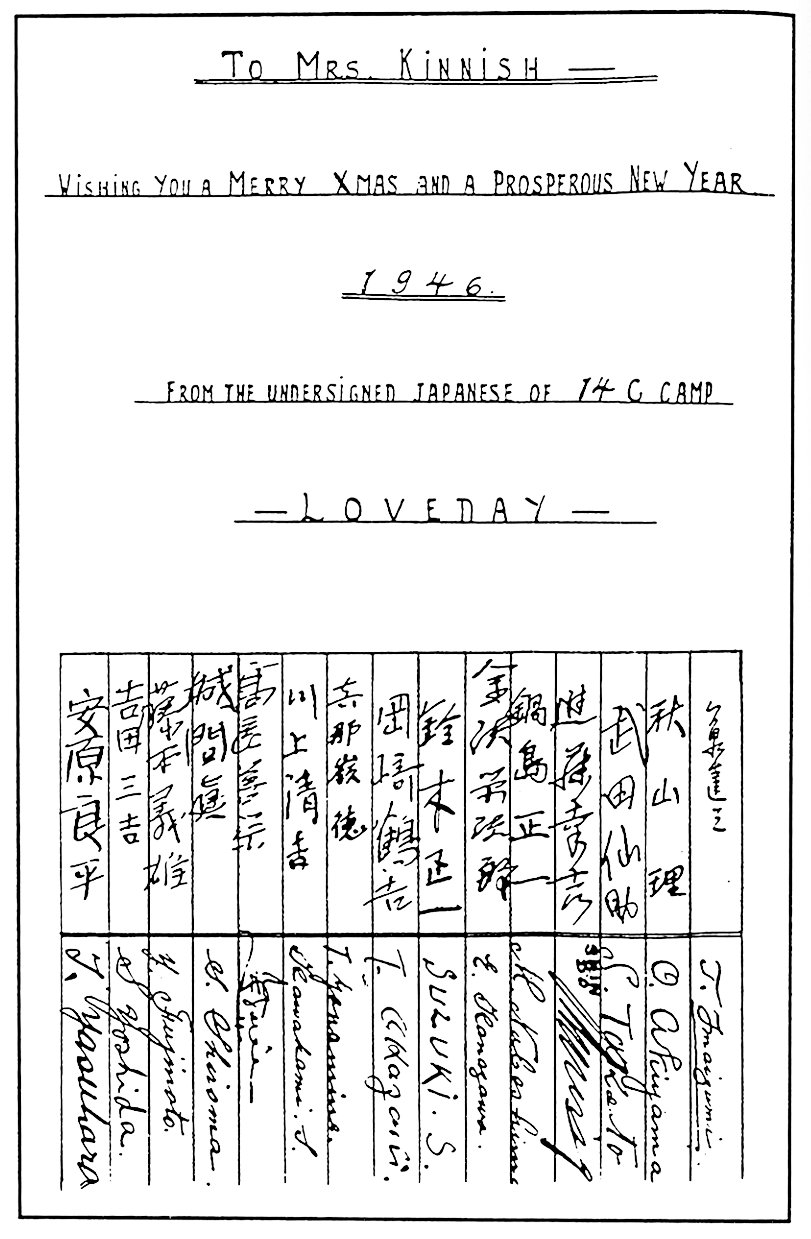
Image of Christmas card in English and Japanese
The internees at Hay and Loveday, being exclusively male, were guarded by male AMF personnel. As the camp at Tatura held women, it was necessary to appoint female guards, who were known as wardens. Two senior wardens and six junior wardens were appointed to look after women and children in the camp.62 Among them was Frances Sproat who was the daughter of Major James Sproat, commandant in charge of German family internees in Camp 3 at Tatura. She was one of the longest-serving wardens and remained at Camp 4 until it was discontinued.63 Women and children were searched by female wardens only.64 According to Sproat, one of the wardens’ tasks was to search daily for heaters, which were strictly banned for safety reasons. Hammond writes that, “internees devised a way to keep their feet warm by filling kerosene tins with boiling water and covering them with blankets”.65 The wardens had close contact with female internees. If an internee had to go to hospital to have a baby, a warden would accompany her and the nurse caring for her. Yuri Murayama talked about Miss Bunting, a senior warden:
We had six children when we arrived at the camp and two more were born in the camp. Miss Bunting was a big woman, kind … always understanding. They looked after us well. I had little worry about having a baby there.66
Ethel Punshon, a junior warden, had studied Japanese before the war with Professor Inagaki, who was interned in the camp.67 According to Punshon, Major Scurry, the Number 4 camp commandant, was concerned with the birth rate in Number 4 Camp and told Japanese compound leaders that there were to be no more babies. His warning had no effect.68 It is unknown how many babies were born to Japanese at Tatura, but one record shows that 7 of 16 local Japanese families had had a birth in the camp by June 1943.69
Major Scurry is well-remembered by former internees of Tatura. Albert Ueno, the former Leader of B Compound, said, “Major Scurry was a fine man and was respected by internees”.70 James Sullivan, a former guard officer at Tatura, remembers one incident:
The troops were anxious to give him a farewell dinner, and they all wanted to be at the dinner, but the problem was to find guards, so I approached Number 3 Camp and asked if they could help out on that night. They agreed. I told Scurry this and he was very pleased. The next morning he called me to his office and told me to forget about the Number 3 camp assistance … He told me that he had spoken to the compound leaders and that they said they would look after things, … The night of the dinner there was not one incident in the compounds. This I mention – as to what the people thought of Scurry – and he was very good to them as he was to all of us … Many internees cried when he left.71
Sullivan himself was remembered well by many former internees. Evelyn Suzuki, née Yamashita, recalled: “He was a bit apprehensive towards us when he first came to the camp, but soon became friendly … he was one of the most popular officers.”72 Sullivan had been wounded in New Guinea and was posted to Number 4 camp after being discharged from Heidelberg Military Hospital as Class B.73 Many former internees who were children at the time remembered this 22-year-old lieutenant as one of the most friendly officers. Sullivan wrote in 1985:
I used to give the children lollies and teach them about Australia and our games. They in turn taught me Japanese, Malay and Chinese … Some of the supper (for local social events) I had prepared by the Japanese cooks in the compound, and when supper time was ready our drivers would pick it up out of the compound and take it straight to the tables in the supper hall. I often wondered, if the locals had known, what they would have done to me, sitting down to a supper prepared by Japanese.74
Sullivan occasionally did things with internees which could have resulted in his detention. He took some children out on a truck to buy them ice cream. One evening he took some Formosan internees out to clean and prepare the Shire Hall for a local ball. He described what happened that evening:
Coming back the boys were shiacking in the back of the truck when one fell out and took nearly all his skin off. The driver stopped the truck in a hurry, we gathered him up, rushed him back to camp, got Ann Chen, who was in charge of the Chinese compound hospital … bandaged him up and got him to bed … I said to Ann, “Do you know what happened to him.” Ann said, “No, Sir.” The next morning when the camp commandant inspected the hospital and said, “What happened to him?” Ann said, “Sir, he fell over playing football” … never breathing a word of what really did happen as they were not supposed to be out of the camp area at night.75
Sai Kwie Kie, a former Formosan internee of Compound A, wrote to Sullivan in 1946 from Taiwan:
Many thanks for your kindness and assistance during our stay in Australia. Your valuable services rendered to us in the past will always in our memory. It is beyond my pen to describe your help to us.76
One of the first things the internees were asked to do was to form a committee. The committee usually consisted of a compound leader and a deputy, a secretary, quartermaster, banker, librarian, canteen supervisor, works manager and one hut leader from each sleeping hut. The hut leader was selected by the members of each hut and appointed by the camp commandant. The hut leader was responsible to the compound leader for the maintenance of discipline and internal economy arrangements. A compound leader was selected in the same way as selecting a hut leader.77 Evidence suggests that compound leaders in Japanese compounds were older, competent in English and socially prominent. Some had been presidents or committee members of Ninhonjin-kai, including Haruyoshi Yamashita, a former president of the Nihonjin-kai on Thursday Island; Yasukichi Murakami, a former president in Darwin; and Miki Tsutsumi, a former secretary in Broome, all of whom served as compound leaders at Tatura at some time. According to former internees of Loveday, before the prisoner exchange took place most positions as compound leaders and committee members were held by employees of big companies from NEI,78 including Kaizoo Sakimura, manager of the Surabaya branch of the Shoogin Bank.79 Because these men had already been prominent members of the Japanese community, and because some of the social hierarchy of civilian life carried over into the compounds, the leaders and committee members were able to exercise considerable authority and control over the lives of internees. Bob Margitich said:
I used to be a bit set back by the way some of the administration in the compound used to speak to them. It appeared to me that they were really cutting crook at them … but that was their idea of discipline … they preferred that type of living.80
In addition to competence in English, the camp authorities wanted to appoint compound leaders who did not have an attitude which would lead to disturbances in the compound.81 It was seldom necessary for camp commandants to remove compound leaders from office, and relations between camp staff and compound leaders were generally good. However, one Japanese compound leader at Loveday was dismissed by the camp commandant because of his incompetence and unwillingness to cooperate with the authorities. When he was removed, his committee members all resigned to “save face”.82 Committees met frequently to arrange compound affairs.83 Their duties were to assist the camp commandant in the smooth running of compounds, and to look after various aspects of internee life.
The Australian government agreed with the United Kingdom with respect to the treatment of civilian internees. All internees were to be treated in accordance with the provisions of the Prisoners of War Convention signed at Geneva in 1929.84 The internees lived a communal life – waking up at the same time, eating the same meals together and going to bed at the same time. It was basically an army life. They were given the same amount of food and the same number of blankets as AMF personnel. The food ration for internees was provided for in National Security (Internment Camps) Regulations Number 18:
The food ration of adult male internees shall be equivalent in quantity and quality to that of the soldiers at the internment camp, and sufficient drinking water shall be supplied to them.85
Bob Margitich at Loveday confirmed:
They lived a life exactly the same as the troops. There was no difference at all. Army personnel above me, they were always very conscientious … If reductions were to be made, the troops had the same reduction as what internees would get.86
Shigeru Nakabayashi recalled:
Did we eat a lot! … We soon regained good health, but also got fat from doing nothing but eating regularly. We had eggs, bacon, meat – so much food! If you ate more, they gave you more. After a while, we began eating less, but didn’t want to have our rations cut down. So we buried some of the unused food.87
Bert Whitmore began work at Loveday before the internees arrived and continued after they had all left. He was in charge of demolishing the camp. He said:
There was enough food. For example, when the camp was closed I was there. I saw a lot of dried food and other foodstuff left lying around the Japanese compounds.88
In consultation with the internees’ committees, quantities of each food item were usually adjusted to suit the requirements of each nationality. The quantity of food for children was calculated on the basis of an approved national scale.89 Taishiro Mori, a former internee at Tatura, said:
We were fed well. I had never seen so much milk before. Japanese don’t drink milk like Australians do. Even the children couldn’t finish their allocated amount. So we polished the floors of our huts with it. The floors became so shiny that things were reflected in them. Some women had a milk bath.90
Shinji Kondo, a former internee from Borneo who worked in the kitchen at Tatura, recalled that there were often surplus eggs which they used to bake cakes.91
The camp staff were flexible in meeting internees’ requests for food. The Italians wanted more bread, flour and spaghetti, whereas the Japanese requested less meat but more rice. In the early days they got polished rice, but later brown rice. Chinenji Kaino, a former internee at Hay, said:
We wanted to eat white rice, so we tried to remove the husks but couldn’t do it well. So we asked for white rice. But it seemed there was no white rice easily available.92
Alcohol was prohibited, but internees of all nationalities made illegal alcohol in the compounds. At Loveday Italians distilled spirits from grapes and currants sold in their canteen. Japanese copied this method.93 At Christmas the internees were able to enjoy a glass of beer supplied by camp administrations in all three camps. On 26 December 1942 Taishiro Mori noted in his diary: “We drank beer yesterday. It was the first beer since we were interned last year. We enjoyed ourselves a lot. It was a rest day for us.”94
All male internees were issued with AMF uniforms dyed burgundy – they were not permitted to wear khaki clothing for security reasons. They were allowed to wear their own clothes inside the compound, but outside they had to wear the burgundy uniforms. The Australian government introduced clothing rationing for civilians in June 1942. Internees also became eligible for clothing ration coupons with which they could purchase extra garments, either at the camp canteen or from outside. At the family camp, clothing for women and children was made by the internees in the clothing factory, but various purchases were also made through commercial suppliers such as Myers in Melbourne.95
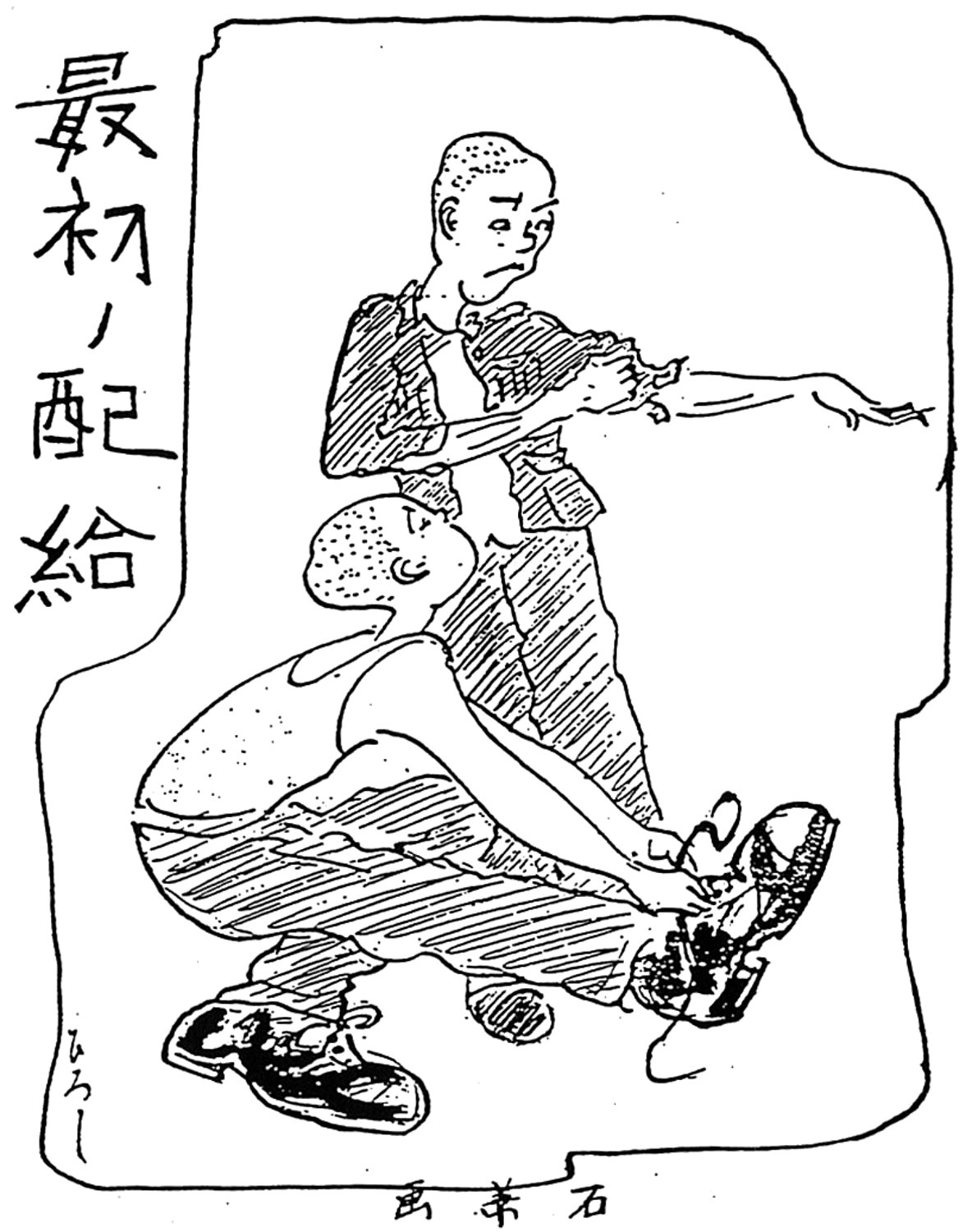
Image of illustration with Japanese text ‘The first supply of clothing’ by Mr Ishikane
Despite these freedoms, it was made clear to internees that they were “prisoners”. There were various restrictions and rules of conduct which were laid down in the Internment Camp Rules and Camp Orders under National Security Regulations Number 14, and which were translated into Japanese.96 Apart from the expected rules about obeying orders and not escaping, these regulations also attempted to enforce respectful behaviour. Rules covering this aspect of camp life stated that internees should not:
- treat with disrespect any Official Visitor, any Officer or soldier …
- swear, curse, or use any abusive, insolent, indecent, threatening or other improper language.
- commit any indecent act or make any indecent gesture.97
Rules controlling camp security stated that an internee should not:
- have in his quarters or possession any article in contravention of Internment Camp Orders or the Camp Rules.
- use or offer personal violence to any officer or soldier, or any other person in the Camp.
- approach within three yards of the boundary fence.
- interfere in any way with the … lighting system of the camp.98
The final catch-all rule was that internees must not “offend in any way against good order or discipline”.99
The inspection report of the Loveday Internment Camps for 5 January 1943 reads: “the demeanour of internees varies between compounds. In the Japanese compounds it leaves nothing to be desired.”100 A Loveday camp official described the three different groups of internees as follows:
- The Germans: arrogant – appreciated strict discipline and firm control.
- The Italians: naturally temperamental, needed firm handling, but once shown who was in control had to be led like a schoolboy.
- The Japanese: subservient – were model prisoners. Their fanatical desire to maintain “face” made them easy to handle in their eagerness to obey all orders and instructions to the letter.101
Bob Margitich commented:
I thought they (the Japanese) were very sensible, which I think is very important if you are an internee … You couldn’t be stupid like Italians or some of the Germans who were that stupid they used to do things that worked against them.102
Shigeru Nakabayashi occasionally observed the Italians through the fence:
They looked so easy-going. They were sent to the detention block very often … carrying a blanket over their shoulder and happily singing a song as they went … Compared to them we were very serious, I suppose. There weren’t many who broke camp rules to begin with. I think most Japanese thought they should obey rules when captured. That was the education in Japan.103
However, there were instances where the Japanese offended camp rules. According to Koike, in the early days a group of internees in 14 B at Loveday protested to the internee committee about saying “Here, sir.” to the officer at roll calls. The committee settled this case without bringing it to the authorities’ attention.104
Internees charged with contravening any regulation were brought before the camp commandant. If they were found guilty, punishment could be imposed. This ranged from confinement in the camp detention block for a maximum of 28 days, to suspension of privileges. One Australian-born Japanese at Tatura answered an officer, “I don’t care what you do, you can go as hard as you like”, when he was accused of being lazy at his work. He was given 1-day detention.105 At Loveday, a Japanese internee attacked and struck another Japanese on the back of the head with a piece of wood. He got 10 days’ detention.106 If internees had any complaints about their treatment or conditions, they had the further option of complaining to official visitors, who were appointed to carry out duties as representatives of Protecting Powers or the International Red Cross, and they were able to visit camps and inspect conditions periodically.107
Internees were not allowed to possess anything which could be used as a weapon, cameras, radios, inflammable articles or unauthorised newspapers and periodicals.108 Internees’ sleeping quarters were regularly searched by officers.109 The general censorship policy limited access to news which might cause unnecessary disturbances among internees, but it seems that almost all the war news printed in local newspapers was available to them.110 The news was translated into Japanese and put on a notice board. Radio broadcasts were not censored, but could only be listened to at certain hours of the day.111 According to Imaizumi, internees could listen to musical programs and the news, but not news commentaries.112
Mail was censored in the same way as army mail. Censorship of the inwards and outwards mail was carried out by camp interpreter officers. People writing in Japanese had to use a certain style of Japanese character. Internees were not allowed to write about camp matters. The following portion of a letter written by Eng Sin Kwee, a Formosan internee in 14C, to his friend in 14B was taken notice of by the authorities:
After the other day, we could not play even our favourite games of tennis and baseball. The pocketbooks which uncle sent … were confiscated by the examining soldier … They were sent so I would study painstakingly the Japanese language and it is a pity that we are not free and can do nothing about it. Soon I think I will apply to the military authorities for permission to receive these books …113
Each internee was allowed to write two letters a week within Australia and they could not be sent out on the same day. They had to get special permission for air mail.114
The camp paymaster placed all money taken from internees in an account in their names. They were allowed to withdraw up to £5 a week.115 At Loveday, instead of Australian currency, printed paper coupons were used until July 1943, when metal tokens were introduced.116 Coupons were also used at Hay and Tatura.117 Internees could buy personal requirements at the canteen, which they staffed themselves. They could also purchase special requirements from outside when they were not available at the canteen. The camp commandant had to approve these purchases and internees received profits from canteen sales.118 They generally handled the profits well. However, in August 1944 the Woolenook compound leader reported one incident where a canteen clerk misappropriated compound funds.119 He was removed from Woolenook Camp.120
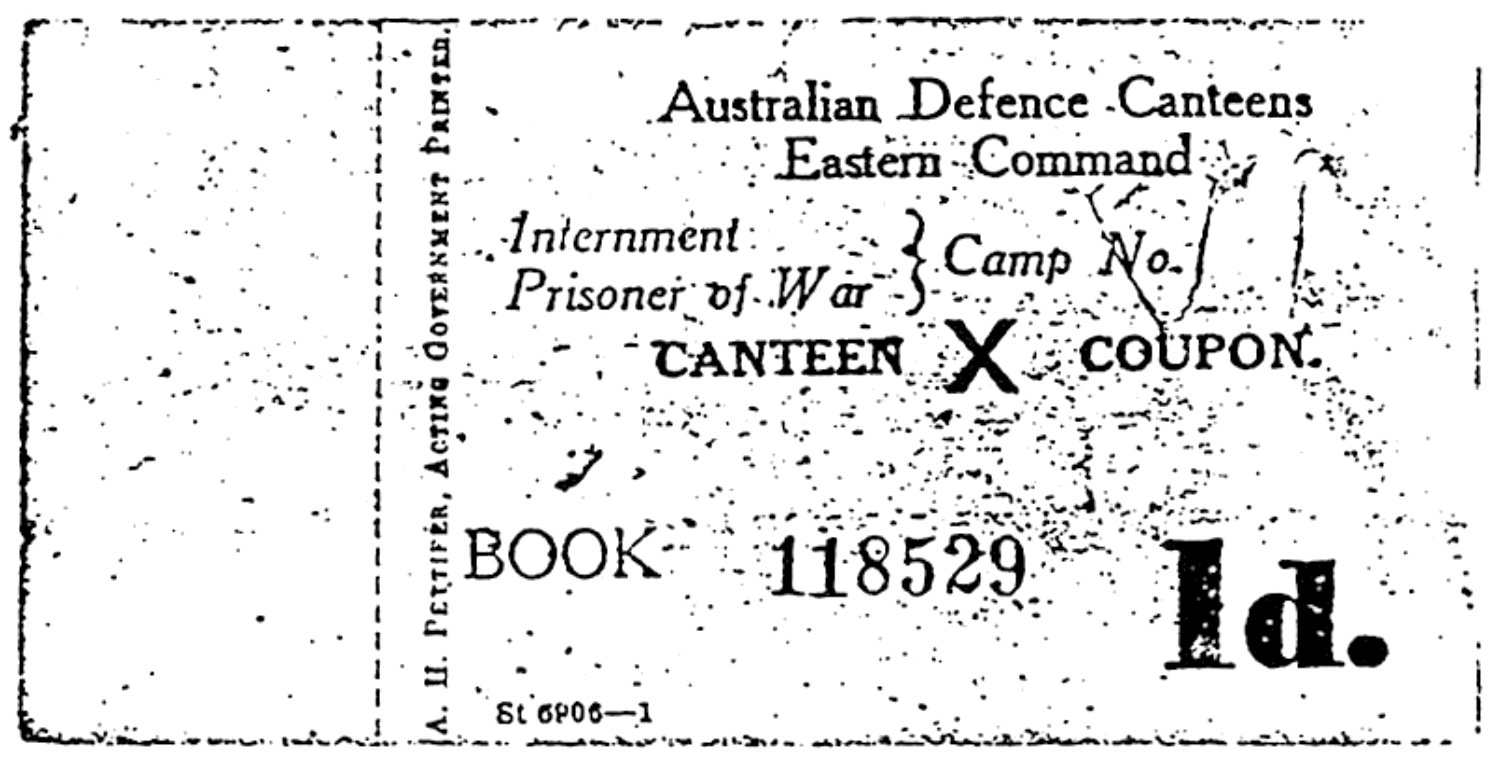
Image of canteen coupon
Under Article 14 of the Geneva Convention, medical treatment of POWs and internees was to be provided free by the detaining power, except for specialist treatment which required special surgical appliances.121 As internees in general had a larger age range, they were more of a medical liability than POWs. Sick parades were held daily and the camp medical officer (CMO) kept a diary of all internees reporting sick. Because of the risk of transmission of diseases, not only within the camps but also to the civilian population, camp authorities were strict about sanitary conditions and held medical inspections at least once a month.122 According to John Shepherd, a former senior medical officer at Loveday, the Japanese there had a high incidence of tuberculosis, malaria and syphilis.123 Internee doctors, if present, were asked to assist the CMO.124 At Loveday there were a few Japanese internees who had been in the medical profession before internment.125 At Tatura, a Formosan internee from NEI served as an internee doctor.126
In the early years of the war there was a lack of camp hospitals, and local civilian or military hospitals were used to treat prisoners. However, there were difficulties with respect to segregation and security. With the completion of camp hospitals in permanent camps, the difficulties were removed. In these hospitals prisoners were segregated in accordance with general policy to prevent contact between different groups of prisoners. Europeans and “Asiatics” were not placed in the same wards.127 At Hay the camp hospital was erected adjoining the local District Hospital,128 while at Loveday the camp hospital was inside the perimeter of 14B Compound and received patients from all compounds.129 Loveday had 40 beds allotted for tuberculosis patients. In December 1943 Japanese occupied 30 of these, so European tuberculosis patients were transferred to the Waranga Military Hospital at Tatura.130 This hospital was established in November 1941 and accepted patients from POW and internment camps around Murchison, Tatura, Myrtleford and Rushworth.131
According to an army report, members of the Australian Army Nursing Service did not attend Japanese POWs: “The attitude of Japanese patients towards nursing sisters was both insolent and disrespectful and members of the AAMS greatly disliked the duty of attending them.”132 This was not the case with Japanese internees. Former Army nursing staff who looked after Japanese recalled no major problems. Taishiro Mori was taken to the Waranga Hospital when he broke his leg. He said in 1987: “I still remember the nurse who looked after me. I fell in love with her, but couldn’t do anything about it. I wonder what became of her.”133
One hundred and eight Japanese died in Loveday, mostly from illness and old age.134 They were buried in the Barmera cemetery, but in 1964 their remains were moved to Cowra Japanese War Cemetery along with the remains of Japanese internees and POWs from other areas. Forty-six Japanese were included in Tatura cemetery burials during the war.135 They were also moved to Cowra in 1964. The numbers of deaths which occurred at Hay is not known, but Chinenji Kaino, a former PWJM, said deaths did occur there. According to the list of burials at Cowra Japanese War Cemetery, 215 were identified as Japanese civilians who died in internment camps or during the Darwin bombing.136 Some ex-internees claim that all Japanese residents of Darwin were interned before the bombing,137 so the inclusion of Japanese who supposedly died during the Darwin raids is open to question. It is most likely that at least some, if not all of the remaining number includes remains transferred from Hay.
According to the Geneva Convention, internees were not obliged to work, but could volunteer. The general policy for the use of POW and internee labour read:
The manpower position of the Commonwealth requires that the maximum use be made of all available POW and Internee labour. The product of such labour can be a valuable contribution to our national war effort and can also help to offset the loss of manpower occasioned by garrison personnel having to be allotted duty at POW and Internee Camps.138
Paid employment projects included market gardening, camp construction and improvement, cooking, tailoring and mending, boot repair, firewood cutting, and keeping pigs and fowls.139 Loveday and Hay, where many internees were available for such labour, had large and varied programs of agricultural production. This applied to a lesser degree at Tatura, where there were fewer men. All were paid at the rate of one shilling a day.140
Lieutenant-Colonel Dean, commandant of Loveday Internment Group, a pastoralist before the war, had a strong interest in utilising internee labour, and set about clearing scrub and bringing the area into production under irrigation.141 The first projects at Loveday were market gardening and animal husbandry. These gradually developed into a large operation producing pigs, poultry and two “secret projects” – pyrethrum for insecticides and opium poppies for morphine, which were needed for both army and civilian use. The first poppy harvest provided more than half the morphine requirements of the AMF for 1944. Bert Whitmore recalled:
They (the Japanese) were harvesting pyrethrum, but it irritated their eyes. So they complained and went on a strike. I went out by myself and could last only half an hour. In the end they finished the job.142
The Adelaide Advertiser reported:
The story of the Loveday Internment Camps is much more than a record of Army life inside a barbed wire enclosure … It is, indeed, a story of vision and enterprise which gave Australia a war contribution seldom equalled, and which provides an object lesson to those who foresee some of the vast potentialities of the River Murray … Altogether, there are about 40 projects in which internees are engaged at Loveday, and each has made a substantial contribution to the group’s success …143
The paper reported that the 440 acres of land in use at Loveday produced goods worth £400,000. This was claimed to be more than the combined output of all the other camps in Australia.144
There were work camps outside the main camps. At Loveday three subsidiary camps, called wood camps, were built to supply firewood for camp use and for engines pumping water from the River Murray for irrigation settlements in the district.145 These pumping stations used 2,000 tons of firewood a year.146 Because of a severe shortage of civilian labour, internees were paid to be woodcutters. Three wood camps, at Katarapko (until September 1942), Moorook West (until January 1944), and Woolenook (until May 1945), supplied fuel for the pumps.147 In May 1942 108 Italian POWs were brought to the camps from Murchison POW Camp, Victoria and in February 1943 Japanese internees replaced them.148 As the Japanese internees were subject to tropical diseases, they were not permitted near the River Murray until they had been certified free of disease by a medical officer.149 They were also examined for other infectious diseases, including tuberculosis and venereal disease,150 to ensure that they were physically capable of hard labour. Evidence suggests that those chosen to work in the wood camps were proud of the fact. The following case was mentioned in an intelligence report of 13 July 1943:
Lam Hien Sai, a Formosan, who was returned to 14B from the Moorook Wood camp because of his weak chest, was so ashamed to return to the camp after volunteering for woodcutting. He expected to live in a detention cell for the rest of his internment.151
In mid-1943 Cabinet decided that priority for paid employment would be given to poor internees.152 Internees from New Caledonia were especially poor and were in the majority at the wood camps. In February 1944, 285 internees were at Woolenook, including 216 from New Caledonia, 39 from NEI and 17 locals.153 Internees who were not able to work or who were particularly needy were able to receive items paid for by Japanese Red Cross funds.154
Not all Japanese were willing to be employed. Some Japanese took the view that any work was indirectly giving assistance to the enemy and refused to take part. According to Chikanari, a former committee member of 14B, this was particularly the case for overseas internees.155 In the early months of internment in 14B at Loveday there was a general reluctance about volunteering for paid employment. However, some made a request to the 14B internee committee to take part because they needed the money, and the committee decided to go along with the scheme.156 In February 1944 it was reported that 36 per cent of the internees in 14B and 31 per cent in 14C were participating in work projects.157 Jimmy Chi, who was at 14 B before going to Woolenook, said:
There were some who never worked. They said that they would not do anything for the enemy. We (Australian-born) never worried about anything like that.158
Former internees of 14B recalled:
Although we participated in work projects, some of us still couldn’t forget that they were working for the enemy. They did things like planting rubber seedling upside down so that they wouldn’t grow.159
If internees were injured while working they were paid at the same rate until they recovered.160 On 8 December 1944 the Loveday war diary recorded:
8 injuries in 7 days mostly very minor and suspect internees trading on Ex-Gratia payment system … On enquiry showing neglect no payment would be made.161
A postwar report on Japanese POW and internee labour stated:
Japanese internees were to some extent better suited for employment outside camps but in the interests of security their employment on other than camp maintenance and duties was not approved except in special cases … In the Loveday area, South Australia, Japanese internees were employed … on the large scale farming projects … and they performed their tasks satisfactorily. Mounted and unmounted guards were used to maintain security but the internees showed little inclination to escape.162
Various projects were also undertaken at Hay.
The camp was regarded as a showpiece and became self-sufficient in poultry, pigs, eggs, milk, vegetables; even producing cotton and other crops … the prisoners and internees actually provided public services – drainage and sewerage – in the town.163
However, in August 1943 the participation rate of the PWJMs was only 16 per cent. The authorities reported that this low rate was due to protests against reclassification.164 According to an intelligence report of 7 April 1945, PWJMs at Hay were engaged in brick-making formerly carried out by Italians, and they did “very satisfactory work”.165 On the other hand, on 12 November 1945 the leader of the woodcutting party was removed because production fell below quota.166
Before the prisoner exchange in August 1942 many company employees at Tatura did not participate in employment projects. Shinpei Murayama, who had been a tailor in Noumea, said:
Employees of big firms like Mitsubishi and Mitsui looked so scared about anything which could indicate cooperation with Australia. The news reporter from the Asahi, for example, spoke very good English but never offered help to officers.167
According to an inspection report of 6 March 1944, 35 per cent of the internee population at Tatura were engaged on various work projects.168 The camp authorities considered this participation rate “highly satisfactory”, considering that the male adult population accounted for only 28 per cent. Work projects included firewood cutting, market gardening, road making, building camp facilities, tailoring and dressmaking.169 Tamiya Nakata, 16 years old in 1942, recalled:
Men of the camp capable of working went to work as carpenters, boot makers and gardeners, paid at one shilling a day for five and half days per week, six hours a day. I joined the carpenters. The first thing we built was a school in the camp, then a large storage shed.170
Women were employed in a clothing factory set up inside the compound. Shinpei Murayama was in charge of the clothing factory where he taught about 180 women. As female internees and children were not supplied with Army uniforms, they made their own garments from second-hand clothes sent from welfare organisations such as the Salvation Army.171
The authorities thought that such “employment projects help to prevent mental and physical deterioration of POWs and internees”.172 Former internees agree. Jitsuzo Oku, a former PWJM, worked at Woolenook before he was transferred to Hay. He recalled: “Life in the camp was not bad. We worked during the day cutting firewood. Because we were working, our minds were occupied. The work kept us going …”173 Chinenji Kaino, also a former PWJM, was at Woolenook:
We were put into small groups for cutting trees. We felt a bit competitive with each other. That group cut down five and that one seven, etc. I think that competition was good for our minds.174
Tatsuzo Imaizumi was employed at the poultry farm at Loveday:
To deviate our attention from the monotonous life in the camp … Most of the internees seemed to be happy with the assignment they were being entrusted with … These works helped us greatly in preserving our physical condition as well as maintain the stability of our mental and moral state …175
Some Italian and German internees attempted escape. At Loveday a few internees escaped from working parties outside the compounds and one internee escaped through the fence. None remained at large for more than 3 days. German internees in Camp 10 planned a mass escape through a tunnel, but it was discovered before completion. No Japanese internees attempted to escape.176 Frank Main, a former guard at the Woolenook Wood Camp, accompanied Japanese internees engaged in wood cutting. He recalled:
One day when we came back from the day’s work, we found one internee missing from the work group we accompanied. We got really worried. I thought he had escaped. But soon we saw him at the gate calling out, “Let me in. Let me in”. The chap was almost in tears. Later I was told that he went to relieve himself and when he came back we were all gone.177
A similar story was told by a Hay resident about a PWJM:
Our family kept cattle then. The Japanese often came to collect manure for their vegie gardens. Two guards were with them. The working party leaving our place left one Jap who went to relieve himself. The guards didn’t count the Japanese or anything. The one who was left on our farm looked really panicky and shot off to catch up with them.178
Bob Margitich believed “there was no need for them (the Japanese) to escape”. He commented:
The Japanese were prepared to accept for many reasons. I don’t know what their lifestyle was before they were interned, but they had security and don’t forget they had plenty of medical care. Spectacles were given by the Red Cross. Their lifestyle in there would have been in most cases much better than the life they had before.179
The apparent acceptance by the Japanese was partly because 70 per cent of the internees were from other countries and often viewed the Australian authorities merely as caring for them on behalf of the ruling power in the country where they had been arrested. In particular, those from NEI and New Caledonia expressed resentment about their humiliating treatment at the hands of the Dutch and French authorities. They expressed strong feelings of gratitude to the Australian government for looking after them. In 1985 Imaizumi wrote:
Those years could be considered as a tough life of endurance in such an environment and also we had to withstand the rather rough and inconsistency of the climatical condition prevailing … we as a matter of fact were quite happy and satisfied for being given the protection by the Australian government and being supplied with all the necessities to sustain life in such condition (sic).180
Another possible cause was, as Nakabayashi claimed, their cultural and educational background. They thought they “should obey rules when captured”.181
All former Australian guards interviewed felt that there had been no problems in the Japanese compounds. They had the impression that the Japanese were a cohesive group with little friction. One guard from Hay said: “I would say conditions were good. Although hostility may have existed, it never showed. Perhaps there was silent contempt for each other.”182 This impression was probably gained because relations between Japanese and camp authorities were largely conducted through the camp committees who tried strongly to control any outward signs of discontent.
Internees lived in a world limited by camp routine and daily chores which contrasted strict official discipline with some degree of self-determination. Prisoners had a choice of engaging in paid employment or making the most of the boredom of prison life. There was some internal friction, but camp life was, on the whole, peaceful and gave authorities the impression that the Japanese were usually a harmonious group. What friction did occur was mainly between such groups as the more traditional and nationalistic Japanese, and the Formosans or those Australian-born internees whose main identity was as Australians.
Most former internees interviewed expressed little bitterness about their treatment by the camp authorities and conditions in the camps. This is confirmed in various International Red Cross reports. While some did show resentment at having been prisoners when they had not committed any crimes, particularly among Australian-born internees, the most common attitude was one of resignation and patience.
Notes
- AWM 54, 780/1/6, p. 270. ↩
- Winter, B., Stalag Australia, Angus & Robertson, Sydney, 1986, p. 19. ↩
- Pearl, C., The Dunera Scandal, Angus & Robertson, Sydney, 1983, p. 70. ↩
- Department of Environment and Planning, South Australia, Loveday Internment Camp: Archaeological Report, Adelaide, 1992, p. 9. ↩
- Ibid., p. 11. ↩
- Ibid., p. 12. ↩
- Bevege, p. 289. ↩
- Bevege, p. 84. ↩
- AWM 52, 8/7/43, nominal roll of officers on posted strength, 5 May 1945. ↩
- AWM 54, 780/1/6, p. 277. ↩
- Bossence, W.H., Tatura, Melbourne, Hawthorne Press, 1969, p. 271. ↩
- Bevege, p. 289. ↩
- Beckwith, M., draft research paper, Hay, 1985, p.1. ↩
- Internment in SA, p. 7. ↩
- Woolmer, G., The Barmera Story, Barmera, 1973, p. 71. ↩
- Myra Tunbridge, Adelaide, 23 Oct. 1984. ↩
- Bert Whitmore, Barmera, 8 Sept. 1984. ↩
- AWM 54, 780/1/6, p. 213. ↩
- Internment in S.A, Number 14 camp plan; Diary, 11 June 1942. ↩
- Nominal Roll, held by Mick Beckwith, Hay. ↩
- Tamiya Nakata, Thursday Island, 12 July 1992. ↩
- AWM 54, 780/1/6, pp. 211-213. ↩
- BP 242/1, Q 39362, 23 Dec. 1941. ↩
- AWM 54, 780/1/6, p. 258. ↩
- John Shepherd, Adelaide, 26 June 1985. ↩
- BP 242/1, Q 39362, 23 Dec. 1941. ↩
- AWM 54, 780/1/6, pp. 45-46. ↩
- Ibid. ↩
- Joe Murakami, Yokohama, 25 Jan. 1987. ↩
- Shigeru Nakabayashi, Tokyo, 8 Jan. 1987. ↩
- AP 308/1, 19 shows a complete list of internees of 14B and C Compounds. ↩
- AWM 54, p. 45. The age was later increased to 18. In March 1943 the Alien Classification and Advisory Committee recommended that the age for compulsory alien registration be increased to 18. See Interim Report in Lamidey’s Aliens Control in Australia, p. 6. ↩
- Bevege, p. 308. ↩
- Patrick Ahmat, Perth, 22 Aug. 1987. ↩
- A 437, 46/6/72, List of local Japanese withheld from initial repatriation, 1946. ↩
- Ethel Punshon, Melbourne, 30 Nov. 1985. ↩
- AWM 53, Tatura War Diary, 2 and 4 Jan. 1945. ↩
- MP 742/1, 255/2/283, 5 June 1943. ↩
- MP 742/1, 255/2/283, 12 Jan. 1943. ↩
- Ibid., 21 Apr. 1943. ↩
- Ibid., 7 July 1943. ↩
- Ibid., 4 Jan. 1944. ↩
- Ibid., 21 Apr. 1943. ↩
- Ibid., 21 Apr. and 7 July 1943. ↩
- A.7.0.0., 9/11/1/0/2, 6 Oct. 1943. ↩
- Ogawa, p. 259. ↩
- Chinenji Kaino, Wakayama, 26 Jan. 1987, [J]. ↩
- Ibid. ↩
- Ogawa, p. 260. ↩
- Harold White, Dee Why, NSW, letter, 24 June 1986. ↩
- Carr-Greg, Charlotte, Japanese Prisoners of War in Revolt, University of Queensland Press, 1978, p. 36. ↩
- Charlie Clift, Hay, 25 May 1986. ↩
- MP 742/1, 255/10/173, 1 June 1945. ↩
- Name withheld, 11 Oct. 1984. ↩
- AP 308/1, 12. ↩
- Internment Policy, 9 May 1941. ↩
- Tatsuzo Imaizumi, letter, 25 Apr. 1985. ↩
- Ibid. ↩
- Shigeru Nakabayashi, Tokyo, 8 Jan. 1987, [J]. ↩
- David Shaw, Berri, South Australia (SA), 8 Sept. 1984. ↩
- Bob Margitich, Adelaide, 6 Sept. 1984. ↩
- AWM 54, 780/1/6, p. 277. ↩
- Hammond, p. 122. ↩
- MP 70/1, 36/101/401, 7 March 1942 ↩
- Hammond, p. 122. ↩
- Yuri Murayama, Tokyo, 30 Jan. 1987, [J]. ↩
- Ethel Punshon, Melbourne, 30 Nov. 1985. ↩
- Ibid. ↩
- AP 308/1, 12, Nominal role of local internees, 1941–1943. ↩
- Albert Ueno, 14 Jan. 1987. ↩
- James Sullivan, letter, Melbourne, 25 Oct. 1991. ↩
- Bevelyn Suzuki, Sydney, 22 Aug. 1987. ↩
- James Sullivan, Melbourne, 1 Dec. 1985. ↩
- Ibid. ↩
- Ibid. ↩
- Sai Kwie Kie, letter, 1 June 1946, held by James Sullivan, Melbourne. ↩
- AWM 54, 780/1/6, p. 42. ↩
- Tatsuzo Imaizumi, Osaka, 23 Jan. 1987. ↩
- Miyakatsu Koike, p. 3. ↩
- Bob Margitich, 28 Oct. 1984. ↩
- AWM 54, 780/1/6, p. 274. ↩
- A373, 11181, 8 Apr. 1945. ↩
- Internment in SA, p. 10. ↩
- AWM 54, 780/1/6, p. 6. ↩
- Ibid., p. 75. ↩
- Bob Margitich, Adelaide, 28 Oct. 1984. ↩
- Shigeru Nakabayashi, Tokyo, 8 Jan. 1987. ↩
- Bert Whitmore, Barmera, 8 Sept. 1984. ↩
- AWM 54, pp.75-76. ↩
- Taishiro Mori, Saga, 17 Jan. 1987, [J]. Japanese consider that milk baths make the skin fair. ↩
- Shinji Kondo, Kawasaki, 25 Jan. 1987. ↩
- Chinenji Kaino, 26 Jan. 1987, [J]. ↩
- Loveday Report, p. 41. ↩
- Mori’s Diary, 26 Dec. 1942, [J]. ↩
- AWM 54, 780/1/6, p. 79. ↩
- See Appendix. ↩
- AP 613/10, 83A/1/2, National Security (Internment Camps) Regulations. ↩
- Ibid. ↩
- Ibid. ↩
- AP 613/1, 5 Jan. 1943. ↩
- Internment in SA, p. 10. ↩
- Bob Margitich, Adelaide, 28 Oct. 1984. ↩
- Shigeru Nakabayashi, Tokyo, 8 Jan. 1987, [J]. ↩
- Miyakatsu Koike, diary, 15 June 1942, p. 103. ↩
- AWM 52, 8/7/43, 8 Aug. 1945. ↩
- AWM 52, 8/7/42, 31 Aug. 1944. ↩
- Internment in SA, p. 16 and AWM 54, 780/1/6, p. 32. ↩
- AP 613/10, 83A/1/2, Internment Camp Regulations, Order 7. ↩
- AWM 54, 780/1/6, p. 44. ↩
- AP 613/1, 90/1/155, 5 June 1942, and A 989, 43/925/97 ↩
- Tatsuzo Imaizumi, letter, 10 Dec. 1985. ↩
- Ibid. ↩
- D 1901, K 3313, 20 Aug. 1944. ↩
- AP 613/10, 83A/1/2, Internment Camp Regulations. ↩
- Ibid. ↩
- Internment in SA, p. 13. ↩
- Charley Clift, Hay, 25 May 1986 and Francis Sproat, Melbourne, 15 Aug. 1987. ↩
- Internment in SA, pp. 11 & 15. ↩
- AWM 52, 8/7/42, 29 Aug. 1944. ↩
- Ibid., 31 Aug. 1944. ↩
- AWM 54, 780/1/6, p. 261. ↩
- Ibid., p. 258. ↩
- John Shepherd, Adelaide, 16 Sept. 1985. ↩
- AWM 54, 780/1/6, pp. 258–259. ↩
- John Shepherd, 26 June 1985. ↩
- Mori Taishiro, 17 Jan. 1987. ↩
- AWM 54, 780/1/6, p. 260. ↩
- Ibid. ↩
- Internment in SA, p. 13. ↩
- AWM 54, 780/1/6, p. 260. ↩
- Ibid., p. 261. ↩
- Ibid., p. 260. ↩
- Taishiro Mori, 17 Jan. 1987, [J]. ↩
- Internment in SA, p. 26. ↩
- Judith Foster, Tatura Cemetery Trust, 25 Sept. 1990. ↩
- Register of burials, Cowra Japanese War Cemetery. ↩
- Joe Murakami, 25 Jan. 1987 and the late Masuko Murakami, 29 Aug. 1986. ↩
- AP 613/1, 130/1/7, 2 Nov. 1942. ↩
- A 2673, Vol. 7, p.770, 9 May 1941. ↩
- A 2673, Vol. 7, Cabinet Minutes, Number 1055, May 1941. ↩
- Internment in SA, p. 26. ↩
- Bert Whitmore, Barmera, 8 Sept. 1984. ↩
- Internment in SA, p. 26. ↩
- Ibid. ↩
- Internment in SA, p. 6. ↩
- Murray Pioneer, Renmark, SA, 14 July 1989. ↩
- Internment in SA, pp. 6–7. ↩
- Ibid. ↩
- Ibid., p. 19. ↩
- John Shepherd, Adelaide, 26 June 1985. ↩
- A 989, 43/925/1/97, Intelligence Report to 13 July 1943. ↩
- A 2673, Item Vol. 7, 9 May 1941. ↩
- A.7.0.0., 9/11/1/10/2, 21 Feb. 1944. ↩
- AWM 54, p.60. ↩
- Etsuro Chikanari, Kobe, 12 Jan. 1992. ↩
- Miyakatsu Koike, p. 65. ↩
- A.7.0.0., 9/11/1/10/2, 18 Feb. 1944. ↩
- Jimmy Chi, Broome, 25 Aug. 1986. ↩
- Etsuro Chikanari, Kobe, 12 Jan. 1992. ↩
- A472, W3737, 1942 amendment of the National Security Act 1939–1940. ↩
- AWM 52, 8/7/42, 8 Dec. 1944. ↩
- AWM 54, 780/1/6, p. 234. ↩
- Mick Beckwith, p. 1. ↩
- A.7.0.0., 9/11/1/10/2, 1 July 1944. ↩
- A 373, 11181, 7 Apr. 1945. ↩
- AWM 52, 8/7/20, 12 Nov. 1945. ↩
- Shinpei Murayama, Tokyo, 30 Jan. 1987, [J]. ↩
- A.7.0.0., 9/11/1/10/2, 6 Mar. 1944. ↩
- Ibid. ↩
- Tamiya Nakata, Thursday Island, 12 July 1992. ↩
- Ethel Punshon, Melbourne, 30 Nov. 1985. ↩
- AP 613/1, 130/1/7, 2 Nov. 1942. ↩
- Jitsuzo Oku, Wakayama, Japan, 17 Jan. 1984, [J]. ↩
- Chinenji Kaino, Wakayama, 26 Jan. 1987, [J]. ↩
- Tatsuzo Imaizumi, letter, 9. Apr. 1985. ↩
- At Loveday, five Germans and four Italians, including two POWs, attempted to escape. They were all traced within 3 days by the late Jimmy James, the well-known tracker, who lived in the River Murray District. Internment in SA, pp. 12–13. ↩
- Frank Main, Adelaide, 1 Jan. 1987. ↩
- A local resident quoted in “Japanese immigrants who contributed for the Japan–Australia Friendly Relations” in Iminkenkyu [The Journal of Immigration/Emigration Studies], Japan International Cooporation Agency, Number 19, Mar. 1982, p. 25. ↩
- Bob Margitich, Adelaide, 28 Oct. 1984. ↩
- Tatuzo Imaizumi, 25 Apr. 1985. ↩
- Shigeru Nakabayashi, 8 Jan. 1987, [J]. ↩
- Harold White, letter, Dee Why, New South Wales, 24 June 1986. ↩