
Chapter 5: Prisoner Exchanges and Early Releases
On 18 August 1942 the Japanese government first exchanged prisoners with the United Kingdom and Dominion governments.1 Australian records show that on 11 October 1940 there were 2,215 British subjects in Japan, comprising 833 men, 921 women and 361 children.2 They included 202 missionaries and nuns, 295 in business and finance, 85 school teachers, and 43 doctors and nurses. It is not indicated how many Australians were among them, but the same records show that on 16 September 1941 about 46 Australians were in the Japanese Empire, excluding members of the Australian Legation. Of these, 34 (10 men, 14 women and 10 children) were evacuated to Australia in October 1941.3 They included six from Mukden, two from Harbin and two from Korea.4
Both sides agreed to exchange all members of embassies, legations and consulates. They also agreed to the repatriation of non-permanent residents and those permanently resident women and children who wished to be repatriated.5 The Australian government, according to Bevege, “desired to exchange Japanese women and all men not regarded as security risks, because internment costs were high and only justified if there was a perceptible gain in security”.6 Both sides also agreed that “the exchange should be without limitation as to numbers and without enquiry into the possible value of those persons concerned to the war effort”.7
The Japanese government sought to exchange 31 people living in Australia in addition to 21 consular officials and their families and employees. They included employees of such Japanese firms as the Yokohama Specie Bank, Mitsui, Mitsubishi and Kanematsu, Kurozumi from the Asahi newspaper, and Professor Seita of the University of Queensland.8 The Japanese government also nominated 74 Japanese from New Caledonia and 715 from NEI9 Loveday officers thought that “those from NEI were all connected with the production of rubber in Malaya and other islands”.10 However, many were employees of banks and trading companies, and proprietors of small businesses.11 Taro Ishii, an internee who was returned to NEI on this exchange, wrote that some were proprietors of local hotels and restaurants who were then used as interpreters by the Japanese Army, while others were encouraged to reopen their hotels and restaurants to cater for Japanese officers.12 Whether they were exchanged for this purpose, or because their pre-war prominence as local citizens had drawn them to the attention of the Japanese authorities, is not known.
At Loveday on 27 July, those nominated for exchange by Japan were gathered in the dining hall without knowing why they were called in. Shigeru Nakabayashi, an employee of Mitsubishi, was one of them. He recalled:
When we were inside the hall, we were told for the first time that we were to return to Japan…I was so happy. We almost said Banzai, but realised that there were more who could not go home so we only said “Ba” and that was it…Those who were outside were watching us through the windows.13
Some names on the lists were unidentifiable, sometimes because names had been wrongly romanised, and sometimes because Japanese names can be written in several ways, depending on which characters are used. Nakabayashi continued:
People who went on the prisoner exchange were prominent people or those who were employed by big Japanese firms. However, there was a lot of confusion when names were called out, and some who were common people or those who had gone native were included by mistake.14
One former internee described those who went on the prisoner exchange as “VIPs”.15 A short list was sent to the Swiss Consul in Melbourne for approval. Some internees named from Japan declined to go, or were too ill to travel.16
At Tatura the names of people nominated by Japan were also announced on 27 July. Taishiro Mori, the son of the coffee plantation owner in the Celebes, found that he was to remain interned in Australia.17 He wrote in his diary that he felt “disappointed and abandoned by Japan”.18 According to former internees at Tatura and Loveday, food was plentiful before the prisoner exchange, but fell off markedly in quantity and quality immediately afterwards.19 Joe Murakami wrote: “we didn’t have any real cause for complaints as it was wartime and rationing was in force throughout Australia.”20
The prisoner exchange disrupted camp life in many ways. Many committee members were repatriated and new committees had to be formed. About half the occupants of C Compound at Tatura were repatriated. Mori wrote in his diary:
July 28 – It (the repatriation) affected many of the young men in the compound. Those who are leaving and those who remain, both sides have to have a strong mind to get through this.21
Lee, a departing Formosan internee at Loveday, left a poem for his friend Yuan:
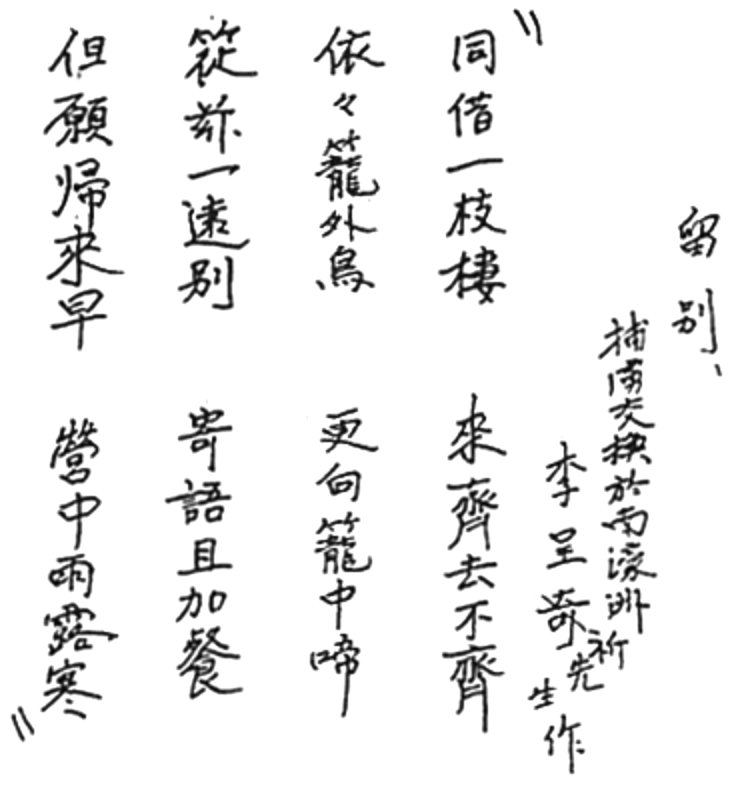
Birds who had nests on the same branch
The day of arrival was the same but leaving separately
I will miss you and care what is going to happen to you
I say to you in the cage many times
We are going to be apart
Come home soon.22
The list of nominees included 27 interned in New Zealand, all of them employees of the Japanese trading company Banno Shookai. They did not go and were still in New Zealand in August 1943.23 To fill the 870 places available on the ship, a supplementary list based on humanitarian considerations was prepared. The Swiss Consul signed these lists.24
On 18 August 1942 the exchange ship City of Canterbury left Melbourne, carrying Australian guards and 871 people – 34 officials, 636 other males and 91 females, 106 children and 4 Siamese nationals.25 Mrs Ichikawa, the wife of the Commercial Secretary of the Japanese Consulate in Sydney, recalled the voyage:
It was a pleasant journey as we were given an individual cabin, but others were crammed into small spaces. Occasionally young men who we knew came to see us and ate some food.26
The voyage took about a month to Lourenco Marques in East Africa. The ship arrived at the same time as the Japanese vessel Kamakura Maru, carrying 150 persons, including 7 Australian diplomatic personnel, 23 non-officials, 71 British nationals, 9 Dutch nationals and 5 other Allied nationals.27 Nakabayashi enjoyed his first glass of beer in six months when they landed:
When I got off the ship, I wasn’t a prisoner any more. I still remember how good I felt then. I didn’t have any money because it was all confiscated when I was arrested. On the ship I was with a man who worked for Mitsui. He had money with him. He bought me a beer. Then we drank a toast and said Banzai.28
The Kamakura Maru took on board the Japanese repatriates and sailed for Singapore. The Japanese Army ordered 289 people to disembark there, and later they were sent to such places as Sumatra, Borneo and Celebes. The ship then disembarked a further 116 people at Java.29 Nakabayashi was disembarked at Singapore. He and three fellow workers were sent back to Butong in Celebes. He said: “I thought my country cared for me and was going to take me home. But it abandoned me there…I was angry and disappointed.”30 They worked on the production of asphalt for sealing runways at the airfield in Kendal. On its completion in June 1944, they were returned to Japan.31
Yuan’s brother was among the Formosan internees on this exchange. He was also disembarked at Singapore, and was returned to Borneo. He later became involved in local guerrilla activities against Japan in Java and was killed by the Japanese Army.32
According to Taro Ishii, who was disembarked at Java, a Mr Matsumoto had been the owner of a hotel called the “Matsumoto Ro” in Surabaya before internment. After Matsumoto was returned to Java, he was recruited as an interpreter in the Jakarta district. The Japanese Army needed interpreters and recruited many long-time residents in Indonesia who not only understood Indonesian and Dutch, but also had local knowledge. They included some from Australia, such as the father of Yooichi Soneda. He spoke both Dutch and Japanese.33 Only 16-year-old Yooichi and his father had been interned, so the rest of the family were waiting in NEI and reunited with their father on his return. According to the son, his father worked as an interpreter at the POW camp and helped Dutch prisoners during the war. After the war he and his family were protected by the Dutch Army.34 Some former prostitutes, mostly over 60, were also recruited. They had not been interned because they had obtained Dutch citizenship through marriage.35 Ishii remained in Indonesia until 1947, to work as an interpreter for war criminals during war crimes trials.36
According to Ishii, some of those who returned to Japan did not stay there long. After a few months they were called up, loaded on the Kamakura Maru, and shipped to Indonesia.37 Over 200 were on board, among them a former managing director of the Kanematsu trading company in Australia, appointed to head a project in Borneo. They were sunk by an American warship in the Sulu Sea and there was only one survivor.38 Some of those who remained in Japan lost their lives in air raids.39
The first prisoner exchange was overwhelmingly in favour of Japan. Immediately after it, the United Kingdom proposed a second exchange in order to secure repatriation of British and Allied nationals from all areas occupied by Japan. On 17 June 1943 there were approximately 1,350 Australian civilians in Japanese occupied areas.40 Australia requested that Australian civilians from Japan, Manchukuo, China, Thailand, French Indochina, Malaya, NEI and the Philippines be included, as well as about 120 Australian officials and 350 non-officials from New Guinea, Nauru and other Pacific Islands. They asked again for the inclusion of two officials, Bowden from Singapore and Ross from Timor, whom the Japanese had refused to include in the first exchange, “justifying their refusal on the grounds that the exchange of officials from Malaya and Timor was not contemplated in original negotiations”.41 Another reason was that many of those Australia requested had already been executed.
On 3 April 1943 the British Foreign Office circulated a memo summarising the protracted attempts it had made to realise this second exchange.42 Despite repeated approaches through the Swiss government, they had been unable to obtain a commitment from the Japanese. Then, on 3 February 1943, the Japanese Foreign Minister, Masayuki Tani, made a statement in a public broadcast which indicated willingness to proceed. Citing “inhuman acts” and “infringements of international law” on the part of Allied countries, Tani claimed that the Japanese were “giving fair and square treatment to the nationals of enemy countries under Japanese control”.43 Encouraged by Tani’s claim that negotiations were being carried out, the British government proceeded to consult with Allied governments to plan a second exchange.44
Japanese internees heard about a second prisoner exchange only as rumour. Those who thought they should have been included in the first exchange were anxious about the news. Mori wrote:
21 August – I hear that there will be a second and a third ship arranged for another prisoner exchange in a few weeks.
13 September – It looks like we are going home next.
30 September – It seems that our departure will be sometime in the middle of October.45
The Japanese government nominated 678 internees to be included in the second exchange. The list included 36 who had originally been included in the list for the first exchange, but who had not been repatriated.46 The rest included about 320 Japanese merchant seamen who had been reclassified as POWs. An examination of the names on the list shows that internees who were long-time residents or those who had established families in Australia were not included.47 According to Mori’s diary, in July 1943 the internees at Tatura were informed in writing by the Swiss consulate that there would probably be a second prisoner exchange in the near future. Mori wrote:
We are all delighted. Those who wished to go on the exchange registered … All of us are in high spirits thinking that it won’t be long to see Japan.48
The 27 Japanese in New Zealand who had been requested for the first exchange were included in the proposed second exchange. They were among Japanese held at Pahiatua in New Zealand who were to be transferred by plane to Australia. The first party of 31 people – 3 Thais and 28 Japanese, including 7 women and 10 children – left by Liberator on 2 August 1943. The aircraft crashed in flames immediately after take-off. Eleven were killed, and the 14 injured were admitted to Auckland Hospital. The survivors were returned to Pahiatua.49 Because of the delay in negotiations for the exchange, the remaining 50 internees were not moved to Australia until transferred by ship in November 1943.50
Negotiations continued for a long time. The Japanese wanted 320 Japanese merchant seamen, a majority of whom had excellent knowledge of Australian waters. General MacArthur supported the strong objections to this request.51 Japan also could not obtain shipping. The exchange did not eventuate.52
Some local internees were given early release in Australia. From November 1940 internees were given the opportunity to appeal to an Aliens Tribunal against internment.53 First they had to write an application for release to the camp commandant, and if that was approved, the Tribunal fixed a time for a hearing. Many Japanese appealed against their internment, but there was debate over whether their cases should be heard by the Tribunal as, according to policy, all Japanese were supposed to be interned. The general policy was also not to release any Japanese internees in Australia, regardless of whether they were local or from overseas.54 In January 1942 the War Cabinet seriously considered not allowing any Japanese to appeal, but “such open discrimination” might “react to the disadvantage of British subjects in Japan” and be “politically embarrassing after the war”.55 At the end of January Cabinet decided to allow extreme cases to be heard. These included internees of use to the defence authorities, or where age, long residence in Australia and family considerations convinced Military Intelligence that the internee proposed for release represented “no security risk”.56
Until the danger of Japanese invasion passed, the number of German and Italian internees did not significantly decrease, but thereafter they were steadily released. This was not so for Japanese.
| Sep–Dec 1942 | Jan–Aug 1943 | Aug 1943– Apr 1944 |
Apr–Dec 1944 | Total | |
|---|---|---|---|---|---|
| Italians | |||||
| Aliens | 29 | 1,078 | 1,552 | 148 | 2,807 |
| NBS | 23 | 294 | 365 | 29 | 711 |
| Aust. born | 1 | 10 | 16 | – | 27 |
| German | |||||
| Aliens | 3 | 47 | 141 | 154 | 350 |
| NBS | 39 | 10 | 47 | 36 | 132 |
| Aust. born | 3 | 5 | 19 | 25 | 59 |
| Japanese | 4 | 10 | 20 | 25 | 59 |
| Finns | 59 | – | – | – | 59 |
| Albanians | 84 | – | – | – | 84 |
| Others | 18 | 89 | 75 | 112 | 294 |
| Total | 268 | 1,543 | 2,235 | 504 | 4,550 |
Note: NBS stands for Naturalised British Subject57
Early in 1942, Aliens Tribunals No. 1 (New South Wales) and No. 4 (Victoria) began hearing cases of Japanese who had appealed. The Tribunals examined their attitudes and whether they were associated with anything Japanese. Four were released. Two women, Veronica Oomori (née Connolly) and Marie Kazumine, were natural-born British subjects from Western Australia. They were released in Victoria in September and November 1942, respectively, under a Restriction Order which prevented them from travelling outside Victoria.58 The only grounds for their internment had been their Japanese descent. Kazumine’s brother, also a natural-born Australian, remained interned throughout the war.59
The other two were Hannah Suzuki from New South Wales and Sho Takasuka from Victoria. Both were born in Japan but came to Australia as young children. Hannah Suzuki’s case was heard before the New South Wales Tribunal on 8 January 1942. She was born in 1920 in Japan to a Japanese father named Shibuya, and an Australian mother, Ada May Shibuya. In 1922 Mrs Shibuya returned to Australia alone accompanying her two children, 2-year-old Hannah and 6-month-old Joseph.60 According to Joseph, “The White Australia Policy was very strictly enforced at that time, and Mother had to obtain special permission from the Prime Minister to re-enter Australia.”61 She was remarried in Sydney to a Japanese laundryman named Sakuhei Suzuki. According to the family, the stepfather was anti-British, while the rest of the family were Australian in outlook and sympathies. Mrs Suzuki was quoted as saying that, “Suzuki had threatened when Joe enlisted that he would shoot the whole family.”62
Hannah was educated in Australia. George Ware, Rector of St Stephen’s Church of England, Hurlstone Park, New South Wales, said that it was a shock to the parishioners when she was interned. He supported her by saying that she was a Sunday School teacher and that no unrest would be caused in the community by her release.63 Several other witnesses gave evidence to the Tribunal that she was “loyal to Australia and anti-Japanese in her outlook”.64 She was released from the Liverpool Internment Camp in May 1942.65 On 30 May 1942 Hannah’s mother wrote about Hannah’s homecoming to her son, Joseph, interned at Hay:
Hannah arrived home and when the neighbours heard that Hannah was home they came and hugged and kissed her just as if it were their own child come home. Everybody claims her, so you can see what an exciting time we are having…Well Dear Joe cheer up and look for the silver lining.66
On 2 August 1942 Hannah wrote to Joseph:
I often get asked about China now, as everyone thinks I’m Chinese! I can remember howling my eyes out when I was a kid because some called me Chinese. In those days it was considered the worst kind of insult to call anyone that, but now people seem to think that I should be more interested in China than Australia…I have noticed that there is a vast difference in the outlook of Australian born Chinese, who are all for China rather than Australia and my own view that as good old Aussie is the only country I have ever known my heart and soul are here…67
Sho Takasuka’s case was heard before Aliens Tribunal No. 4 (Victoria). On 4 June 1942 the Minister for the Army confirmed the Tribunal’s decision to release him.68 He was the only Japanese man released during the first half of 1942. He was one of the sons of Ichiko Takasuka, who had not been interned. At the outbreak of war in Europe Sho wanted to enlist, but his nationality prevented it, so he had joined the Volunteer Defence Corps.69 His Australian-born brother, Joe, volunteered for the Australian Imperial Force (AIF). Joe’s first two applications were, however, rejected under Australian Military Regulations No. 177, which applied the White Australia policy to the armed forces and excluded recruits who were not substantially of European origin. At his third attempt he was finally accepted and enlisted in the Royal Australian Air Force (RAAF).70
There was a lot of support for Sho’s release from his neighbours in Fosterville, Victoria. According to Bevege, possible factors contributing to his release were not only his brother’s active service and his community acceptance, but also his tomato farm, where “20 pickers were employed at harvest time”.71 Food shortages may have been a factor. McKernan says that “during 1942 fruit and vegetables were always in short supply because of the American “invasion”, and prices, consequently, remained high. Many an Australian turned lawns, and even flower beds, into vegetable patches.”72 In fact, the Directorate of Manpower was experiencing “grave difficulty” in obtaining adequate labour to harvest the tomato crop.73 There was the precedent of the release of Italian internees in Western Australia for the same purpose.74 Bevege writes, “the Victorian military authorities may have assessed Takasuka as more valuable back on the farm”.75 He was released on the condition that he not go beyond a radius of 10 miles from his farm, and he returned to his tomato growing in Fosterville. In 1961 Takasuka acquired Australian citizenship, from 1964 to 1970 served on the Council of Huntly Shire, and in 1966 was Shire President.76
Joseph Suzuki, Hannah Suzuki’s younger brother, also appealed. His case was heard on 27 May 1942 before Tribunal No. 4. He came to Australia as a baby and had never returned to Japan, but he unwittingly retained Japanese citizenship. He enlisted in the AIF. He wrote:
I was only 17. I knew that I was entitled to serve Australia, and consequently joined up on June 1940 placing my age at 22 and giving my birthplace as Geelong. The NSW Police registered me as Joseph Suzuki born at Kobe, Japan, on 28th February, 1922. It is apparent that they did not check up, as my actual name is Ichiro Shibuya, born at Kobe, Japan, on 28th February, 1922, who entered Australia on my mother’s passport.77
In February 1941 he was discharged at the request of Military Intelligence on discovery of his nationality78 and was interned on 8 December 1941.
The chairman of the Tribunal, Sharwood, was convinced that he was thoroughly Australian in his outlook and sympathies and that his release would not cause serious unrest in any Australian community.79 He spoke only English and volunteered to serve in the Labour Corps. He was then interned at Woolenook Wood Camp. The O.C. Woolenook said: “He is 100 per cent Australian, hates the Japs and will not associate with them.”80 Captain Gillard, who represented the Army, also agreed that he “possibly had the strongest case for release from internment that one could conceive”.81 On 30 May 1942 his mother wrote to Joseph:
I am glad to hear that you have had your appeal and hope and trust that it won’t be long before we know the results. I guess that it was Father’s suggestion about the whole family wanting to be interned…I would never want to be interned with him…I have retained my British nationality.82
Joe was still in internment in 1944. Enlistment worked against him. A detective in Sydney wrote to the Military Police Intelligence Section to oppose Sharwood’s recommendation for release, stating:
Suzuki is a student surveyor and has been a member of the Australian Military Forces and it is submitted that no better contact could be free to assist his fellow countrymen [sic]. His military training and geographical knowledge would be of the utmost value.83
As one indicator of their attitudes, those appealing against internment were questioned at the hearings about their religion. Although Suzuki was a Christian:
The fact that Joseph Suzuki had accepted the Christian Faith was regarded as an indication that he was not following the Japanese customs and habits. It is pointed out that no reliance can be placed on this claim as in the year 1941 the Department of Education, Japan, announced that official recognition had been granted to the newly established Japanese Christian Association which included 1,600 Churches; 388 religious societies etc. of the Protestant and Catholic faiths.84
Suzuki suffered from the prolonged internment, became mentally ill and was hospitalised in camp.85 On 2 August 1944 he wrote to his aunt:
I must apologise for not writing for some time, but I have been in hospital for the past month or so. Now that I have recovered my health I feel that it is time to speak up and tell everyone what the present government has done to me…Even if I were an enemy alien I would still have a right to produce witnesses, books and documents and have a Tribunal hearing at a pre-arranged time and place. Instead of that I was merely questioned at a moment’s notice, and refused a further hearing. That is what has happened in my case.86
On 4 August 1944, two days after he wrote this letter, his release was finally approved.87 He did not have anything like Sho Takasuka’s tomato farm to contribute to Australia’s war effort. He was also a young man from Sydney where the incursion of Japanese submarines was vividly remembered. After his release, the Sunday Telegraph interviewed Suzuki:
I am an Australian to the backbone, so the worst part of the internment was having to associate with the Japanese…Had there not been three or four other chaps in the same boat as myself (either half-Japanese or born in Australia of Japanese parents), I should have had a very bad time.88
Suzuki applied for naturalisation and it was granted on 12 June 1945. He changed his name in the following month, giving up his Japanese surname.89 He wrote in the application, “my present surname causes considerable embarrassment both to myself and my employers”.90
Samuel Nakashiba was born in Cairns in 1924 to a Japanese father and a white Australian mother of German origin. He was interned with his parents and two Australian-born sisters in Darwin. As he was 16 years old, he was interned at a single men’s camp at Loveday while his family was at Tatura.91 In a letter of appeal in 1944 Samuel wrote:
It is my desire to join one of the services, where I would be able and willing to serve my country’s cause to the best of my ability. You may have some doubts as to my sincerity, because I have been confined with the Japs during my internment… This is no idle whim, being an honest desire to fight for and preserve those attributes of democracy which I, as a British subject, have always been taught to uphold and respect … I was educated and reared in Darwin, have always associated with Australians. I speak no other language than English …
He was released in May 1945.92 After release he abandoned his Japanese surname. He joined the Australian Army and served during the Korean War.93
The case of John Iwamatsu Nakashiba, Samuel’s father, was unusual. Military Security Service reports before the commencement of hostilities with Japan identified him as a potential enemy agent.94 He was a business agent in Darwin for various Japanese companies, and had much to do with the pearling fleets and Japanese vessels in Australian waters. He was also looked upon as the leader of the local Japanese community and was in fact president and secretary of the local Nihonjin-kai.95 After war was declared with Japan, Nakashiba was held in custody by Naval Intelligence, and it later reported he was actively assisting its operations.96 At the same time, Military Intelligence was insisting that he be taken into custody under the “catch-all” provisions for the internment of Japanese. Naval Intelligence recommended his release because of the services he performed for it, but he was interned. His Australian-born wife and daughters nominated to go into custody with him at Tatura. Nakashiba’s son Samuel was interned separately at Loveday. The elder Nakashiba applied for release, but in February 1942 Aliens Tribunal No. 4 rejected his request, having judged him “untrustworthy and unreliable”.97
In March 1942, at the insistence of Naval Intelligence, who pointed out that Nakashiba had been a bona fide intelligence agent for it, the deputy chief of the General Staff petitioned the Department of the Army to approve Nakashiba’s release.98 On 20 March 1942 the Minister for the Army revoked his detention order.99 Nevertheless, in July 1942 Nakashiba was still in internment and further petitioning authorities: “I pray to your honours to protect and guarding upon these helpless and powerless poor souls under the British Justice and Union Jack.”100 Security records show that Nakashiba, his wife and daughter were again interviewed in August 1942, repeating their request to be released.101 Military Intelligence then approached Naval Intelligence asking if they could find employment for Nakashiba. Naval Intelligence replied that “it has not been possible to find suitable employment for … Nakashiba” and that “until such time as (employment) can be effected he should not be released”.102 This reversed the previous position taken by Naval Intelligence. Nakashiba’s wife and daughters were released in 1944.103 Nakashiba remained in internment. After the war, the Director-General of Security recommended that he should be released in Australia on the grounds that “he is of no interest from a security point of view”. He was released sometime after July 1946.104
The alleged Japanese sympathiser, Woodfield, made complaints about his detention and the camp arrangements. He claimed he was not given a proper detention order on his internment and said he should have been treated as an officer. He also resented being interned “under the same conditions as given to the Mediterranean races”.105 Other complaints concerned the quality of food, the internment of his daughter who was under 16, and that his Japanese wife was “of noble birth”. His wife was a British subject by marriage.106 In April 1942 he appealed against the detention of both himself and his wife, but the Advisory Committee for Queensland recommended that they be kept in internment. Again in March 1943 he applied through the Consul-General of Switzerland for his wife to be repatriated, but the request was denied.107
At Tribunal No. 1 hearings, Captain Gillard did not always agree with Mr Sharwood’s recommendations. One case concerned an old Italian-born Japanese woman, Kame Kagami, from East Prahran, Victoria, who had come to Australia in 1891. Her case was heard on 12 February 1942.108 She and Mrs Takasuka were the only two Japanese women who were long-time residents in Victoria who were subject to internment.109 Despite Sharwood’s recommendation for her release, Gillard maintained that the public wanted to see aliens controlled and that Kagami was obviously Japanese.110 Since Kagami is not included on the nominal roll of Tatura internees, or the list of those who died, or the repatriation list compiled after the war, she must have been released at some time before the war ended. Evelyn Suzuki remembered her:
She was a single woman and hardly spoke to anyone in the camp… She could not speak Japanese anyway. She was released very early. I think she may have been suspected as a Japanese sympathiser.111
Until July 1942 the Army was responsible for control of enemy aliens and internees, but then responsibility was passed to the Attorney-General, though the Army remained responsible for actual internment procedures.112 The Attorney-General, Dr H. V. Evatt, told Parliament on 10 September 1942 that:
the objective of Aliens Control is preventive, not punitive, and individual liberty is to be restricted only if the possibility of injury to the nation is undeniable and only to the extent necessary to prevent the injury.113
On 22 September 1942, Evatt appointed Brigadier W. Simpson Director-General of Security. Simpson established the Aliens Classification and Advisory Committee (ACAC), an independent body responsible to him and which was to work closely with him on all matters affecting aliens. Arthur Calwell was appointed chairman.114 The ACAC’s first task was to “re-examine the case-histories of those who had asked for release as well as the generality of all those initially interned on warrants issued as a precautionary measure by the Army authorities”.115 Noel Lamidey, who served as secretary of the ACAC, wrote in 1974:
It was of course inevitable that, in those very early days of the war, hysteria near panic and denunciation played their part, for it is well known that the first casualty in war is truth. As time passed it became clear to many fair-minded people, and in particular to the government in power, to keep under review all forms of restrictions and to amend the regulations where obvious injustice had been perpetrated.116
The number of releases increased greatly from January 1943. Italy capitulated that September and most Italians were released by the end of 1944.117
According to alien registrations of 31 December 1942, twenty-eight Japanese were among those at large and were registered as enemy aliens.
| Nationality | QLD | NSW | Vic | SA | WA | Tas | Total |
|---|---|---|---|---|---|---|---|
| Albanian | 292 | 28 | 500 | 18 | 248 | – | 1,086 |
| Austrian | 38 | 1,323 | 940 | 58 | – | 28 | 2,387 |
| Bulgarian | 15 | 28 | 34 | 122 | 93 | – | 292 |
| Finn | 211 | 186 | 122 | 56 | 59 | 5 | 639 |
| German | 255 | 1,951 | 1,920 | 298 | 260 | 39 | 4,723 |
| Hungarian | 5 | 370 | 198 | 22 | 8 | 2 | 608 |
| Italian | 1,445 | 3322 | 4352 | 1,073 | 2,132 | 24 | 12,348 |
| Japanese | 5 | 6 | 12 | – | 5 | – | 28 |
| Romanian | 13 | 119 | 85 | – | 8 | 2 | 227 |
| Thai | 1 | 1 | 1 | – | 3 | – | 6 |
| Total | 2,280 | 7,334 | 8,164 | 1,647 | 2,816 | 103 | 22,344 |
Victorian and NSW numbers include four internees who were released before December 1942, three in Victoria and one in NSW The rest were not interned.
In March 1942 the War Cabinet decided to make enemy aliens who were not members of the Nazi or Fascist parties available for employment to the Allied Works Council established that February. Japanese were not included in this scheme. In March 1943 ACAC submitted an interim report to Evatt in which it discussed the importance of utilising alien labour.118 The Committee was aware that the United Kingdom had adopted an elastic policy by which almost all enemy aliens were working in industries. The report stated:
We believe that it is now true to say that since the internment of the greater proportion of these Aliens, conditions have materially altered. At the present juncture it is common knowledge that our resources are under constant review with the idea of utilising them to the best advantage. The system of compulsory labour service is now firmly established …the need [is] to avoid permitting men to remain in almost complete idleness when it may be found on examination that no real security risk would be involved in their release for some form of useful national service. The maintenance of large internment camps not only fails to utilise possible available alien labour but also imposes a heavy strain on our Manpower resources…119
The Civil Alien Corps, established as a section of the Allied Works Council, employed more than 1,300 enemy aliens,120 many of them former internees who had been cleared through the security procedures of the Aliens Tribunals. They were paid at the basic rate of the Australian Military Forces scale work including road construction, timber and firewood-getting, charcoal-burning and navvying.121 The work camps were in remote inland areas in places such as the Northern Territory and along the Commonwealth railway line on the Nullarbor Plain.122 The scheme met with limited success.123
Authorities considered that even elderly Japanese males might engage in sabotage.124 In July 1942 a police report from Sydney advised Military Intelligence:
It must be realised that Japanese nationals should be viewed in much different light of those of any other enemy countries, even 65 to 70 years of age and over, are likely to engage in sabotage as a contribution to the Japanese cause… It would be quite a simple matter for even an elderly person to resort to the flashing of an electric torch or even burn his home to guide enemy planes in the event of an air raid.125
The case of Etaro Yamaguchi, a gardener from NSW who was 69 in 1942, presents an interesting comparison with the case of the released tomato grower from Bendigo, Sho Takasuka. Yamaguchi’s former employer, Mr George Koo, appealed for Yamaguchi’s release soon after his arrest on 8 December 1941. On the following day the arresting officer described Yamaguchi:
He has been a resident of the Commonwealth of Australia for the past 47 years…For the past 16 years he has been employed with Chinese in the Goondiwindi, Queensland, and Boomi, New South Wales, districts as a gardener in market gardens. During the past 4 years he has been employed by George Lee Koo, an Australian-born Chinese, as a gardener… The alien has not come under adverse police notice during his residence in the Boomi District and appears to have been a good citizen.126
On 15 December 1941 Mr Koo’s solicitor wrote to Military Police Intelligence in Sydney:
Guchi (Yamaguchi) is the only reliable man available to help our client in his garden, and our client is prepared to go bond to a reasonable amount for the good behaviour of Guchi if it can be arranged.127
He got no reply. On 8 February 1943 he wrote again:
We will be obliged if you will communicate with the Security Service and ask them for an answer one way or another concerning the application we have made for the release of the abovenamed. Our client has a valuable crop and it is in danger of being lost owing to lack of man power…128
On 17 February 1943 the Deputy Director of Security for NSW replied that “Yamaguchi cannot be released from detention at the present time”.129 Yamaguchi was never again to work on Mr Koo’s garden. He was deported to Japan after the war.130
Yet, after the danger of Japanese invasion had passed, old age became a possible ground for release. Two of the ten internees released between January and August 1943 were the elderly laundrymen from Geelong, Furuya and Hasegawa – aged 71 and 73, respectively. Furuya was released in February 1943.131 Although the case of Hasegawa was heard by Tribunal No. 4 on 10 February 1942,132 he was not released until May 1943.133 Nagai, a 66-year-old, was released in September 1943.134 Itoh, the youngest of the four at 61 in 1943, remained in interment until the end of the war.135 According to Hasegawa’s daughter-in-law, Itoh was fitter than the others who were seriously ill and senile. They were released on the condition that they not assist in the conduct of any laundry business which might bring them into contact with the public, and that they not associate or communicate directly or indirectly with enemy aliens or persons of enemy origin other than members of their family. They were under observation by the local police, who reported monthly on their behaviour.136 Hasegawa’s daughter-in-law said:
He could not go out or anything like that. But I suppose it didn’t matter much as he was too ill to do anything anyway after he came out of the camp…One day “Gone with the Wind” was on in the local picture theatre. He said he wanted to see it. “No way”, we said, but I booked tickets anyway. Everyday I thought he would die so I wanted him to do something he liked. I wasn’t afraid. Nobody found out about it.137
Hasegawa was bedridden until he died in 1952.138
Omaye, a laundryman from Sydney, was released at about the same time as Hasegawa. He had been a resident of Australia for over 40 years and had an Australian-born wife.139 They had six children, the oldest of whom was in the AIF. Omaye was suffering from chronic rheumatism. He was released in June 1943 because “his condition would probably improve if released from internment”.140 He was 63 and died 7 months later.141
At Loveday there were many elderly Japanese internees. In May 1944 the camp authorities interviewed some of these with a view to possible release, although the internees were not told this. Their reports show that they were either in the camp hospital or suffering from illness. Tamakichi Koike was interviewed in the camp hospital. He stated:
I am 74 years of age. I have been in Australia about 50 years. Since my arrival in this country I have never returned to Japan. I used to be a carpenter at Cairns in Queensland before I was interned. I owned my own house in Cairns, and lived there with a woman. I am not married to this woman, who is a half-caste, but I was keeping her. Her name is Minnie Gough…All my belongings would be valued at 400 pounds. Minnie is looking after my things for me.142
The camp authorities recommended that he be released as they thought “his woman companion might be agreeable to looking after him”.143 Simpson approved his release on compassionate grounds. He was released in August 1944.144 Yosahatsu Yonezawa, an internee from Western Australia, was also interviewed in the camp hospital. He stated:
I am 80 years of age. I was a pearl diver. I have been paralysed for 18 years. I am not married. I have been in Australia for 67 years and I have never been back to Japan. I have no friends and no relatives in Australia. I have 800 pounds in the bank in Japan for my old age. My health is better since my internment.145
The authorities’ recommendation was that, “It would be better for him to remain in internment camp and receive treatment as he is an old internee who has nowhere to go”.146 He died in the camp hospital on 14 February 1946.147
Kenji Makishima, 73 years old, was also a very sick man:
I have been in Australia for 46 years… I was occupied with doing general duties before I came into internment. I had stock worth over 300 pounds, and my house and furniture would be worth 200 pounds. I lived with an Australian woman and kept her for 6 years…She had three children, but one died…I have bought a house and given this to her. That house is worth 40 pounds. The police are looking after my property. Mrs Weigh of the “Royal Hotel” in Boulia is my best friend. My house has been burned down.148
The authorities commented that he would not live long, and recommended he be released if his friend would look after him. He died, still in camp, on 10 August 1945.149
Hideichiroo Ide arrived in Australia in 1892 and became a naturalised British subject in 1902. He was arrested in December 1941 and was released in late 1944 at 78 years of age. At that time he had been a resident of Sydney for 52 years. He was married to a British woman and they had three sons, two of whom enlisted in the AIF.150 The eldest was too old to enlist. According to Katoo, Ide’s children strongly identified themselves as Australians. Katoo said: “Their activities and achievements are perhaps a good indicator of their identity.” The eldest son was a member of the design committee for the Sydney Harbour Bridge. The second son represented Australia as a member of the Wallabies rugby team. He enlisted in the AIF in 1940, was sent to Singapore in the following year and was taken prisoner by the Japanese in February 1942. After working on the Burma railway, he drowned in September 1944 when a ship carrying Australian POWs to Japan was torpedoed by an American submarine.151
In October 1944 the Brisbane press reported a series of meetings at which the RSL was critical of what it saw as the release of enemy alien internees. The members of the RSL expressed concern that ex-internees would “get themselves entrenched in good jobs while Australia’s own flesh and blood were still fighting”.152 At an RSL meeting on 9 October 1944, S. Prior was reported as complaining about a Japanese internee. He said that a Japanese silk dealer had been released and that he had been seen working in his garden. He also suggested that a public meeting should be held to “protest over the whole question”.153 The internee in question was Kashiwagi who was released on compassionate grounds on 21 December 1943, aged 75. Kashiwagi had lived in Australia for over 50 years, was married to an Australian woman and had an Australian daughter. The Tribunal was convinced that he was “loyal” to Australia and recommended his release on the grounds that he was suffering from advanced heart disease and was a permanent invalid whose expectation of life was short.154 Evatt defended the government: “The release was made in accordance with the Geneva Convention under which the Commonwealth in common with other signatories agreed to release aged and sick internees.”155
Some children of Japanese internees were released to attend school. Although policy did not allow this,156 the authorities were prepared to release them if a school accepted them and if the parents agreed. The eldest two boys of the Takagaki family from Mackay, Jack and Charley, aged 14 and 12, were granted release in October 1943 to attend the Kilmany Park Farm Home for Boys in Victoria.157 On the advice of the camp authorities, they used Griggs, their mother’s maiden name, at Kilmany. Jack talked about their experiences there:
Other boys soon found out that we were part Japanese. They bullied us … I became aggressive and after a while they stopped… That was the only way. I became good at boxing. I even later won a Flyweight Championship in Melbourne.158
According to the eldest daughter of the Yamashita family from Thursday Island, the parents wanted a similar arrangement for their older children, but the camp authorities could not find any school which would accept them.159
According to Bevege, half of those Japanese who appealed decided to withdraw their applications as they were concerned at prevailing public reaction.160 Michael Itoh, an Australian-born subject of Japanese origin, withdrew his appeal, although he was given strong support by the Minister for Lands and Agriculture in Western Australia. The Minister said that Itoh “had been educated at ‘one of Perth’s best colleges’ and was ‘an excellent citizen’ and ‘a good Australian’”.161 He decided to stay in the camp because he felt “public feeling would be against him” if he were outside.162 After the war, Roland Browne, Acting Director-General of the Security Service, described him:
I am satisfied that under any policy other than one of complete internment of Japanese this man’s internment would never have been contemplated and I feel he should be released forthwith without restrictions.163
In the case of 25-year-old Australian-born Douglas Umino, the son of a Japanese father and Australian mother, the Director-General of Security was willing to release him if suitable employment could be found. In April 1945 Umino was offered a position as caretaker of a deserted mine at Forest Reefs near Orange, New South Wales. He decided to stay in internment as he thought the salary for a caretaker would be very little and he would be better off where the government supplied him with food, clothing and medical attention.164 He was released in October 1945165 and returned to his father’s laundry business in Sydney.166
There were about 11 Australian-born internees at Woolenook Wood Camp. All except Joseph Suzuki, Samuel Nakashiba and Eddie Ahmat remained in internment. Patrick Ahmat stayed, while his older brother, Eddie, was released on 17 April 1945,167 and his mother and sister were released from Tatura on 21 October 1944.168 Patrick said that his applications for a hearing were never approved and he gave up applying after a while.169 Jimmy Chi from Broome had a similar story, but was more persistent:
I put my application for hearing many times while I was interned… but no hearing. I don’t know why, but that Captain Brown (camp commandant at Woolenook) was not cooperative about this at all…170
Jack Tolsee preferred to be interned. He said:
Captain Brown said, “Have you got any Japanese blood in you at all?” I said, “No. I am a Sikh,” then he said, “Well, do you want me to make representation to the government?” I said, “No, no.” … From the time I was 6 years old until I was 15, I had to work in the field. I was like a slave, no pay…It was a very sad life. So when they took me (interned), I was so pleased. I was free in the camp.171
Altogether, 69 Japanese were released before postwar repatriation in February 1946.172 Almost all belonged to Category O, which policy described as “ordinary and harmless”, and included 16 women and 14 children.173 Of the 39 men released, 20 were 65 years of age or older and were ill and infirm. Most had been in Australia for over 40 years and had Australian or British-born wives. Seven had sons in the AIF and two were naturalised British subjects.174 The rest included five Australian-born Japanese, one born in New Guinea, and Sho Takasuka. No records have been found concerning the others.
Saunders and Taylor argue that, “From mid 1942 when the initial alarm abated, plans were already underway to utilise the labour resources of all forms of enemy aliens and non-British residents”.175 This was not generally so for Japanese internees. The internment of many Italian farmers in Western Australia in 1940, for instance, threatened the state’s potato crop.176 Cresciani wrote: “The Commonwealth government soon realised that the policy of allowing innocent Italians to return to their occupations was not only an act of justice as well as of economic utility, but also a necessity which in many instances offered no other alternative.”177 Except possibly for Sho Takasuka, the tomato farmer, the Australian government did not see any economic advantage to releasing Japanese. The Japanese community was small and not engaged in industries where their absence caused a serious problem. Releases were limited and only occurred when authorities had exhausted all arguments for keeping the internees in confinement. There was very little readiness to consider each case on its merits. As Bevege writes, “It was the strength of Australian antipathy to the Japanese race as a whole that made it necessary in the interests of law and order, and of morale, to keep them interned for the whole of their time in Australia or for the duration of the war.”178
Dr Evatt had claimed that internment was as much for the “protection” of the enemy aliens as for the war effort. Some of the experiences of children who were released suggest there was animosity outside the camps. Jack Takagaki was released to an educational institution where he became involved in fights with other children.179 Jamel Shibasaki, the eldest son of the Shibasaki family, was 16 years old when he and the family were released in 1943. He also had fights with local children because of his Japanese descent.180 However, other released internees claim they had no problems and were accepted by the local community.181
The failure of the majority of those interned as Japanese to obtain early release shows that the government’s policy was to treat the Japanese as a special case. Noel Lamidey, secretary of the ACAC, confirmed this in 1987:
Our government was firm about the Japanese. As far as I remember, we interned the lot and as a principle, we didn’t intend to let anyone out. It was for their protection.182
Lamidey’s report “Aliens’ Control in Australia” categorises released Italian and German internees into “Alien, Naturalised British Subjects and Australian Born”.183 This suggests preparedness to consider these groups differently. However, despite the existence of naturalised and Australian-born British subjects among the Japanese, there was no sub-division. All were simply classed “Japanese”.
Internment of Japanese was markedly higher than for other alien nationalities and in fact was almost total. The rate of release of other internees was also considerably higher than for Japanese. In the case of Italians, 74 per cent of those interned were released by December 1944 and 40 per cent of them were released before Italy capitulated in September 1943. Twenty-five per cent of Germans were also released by December 1944. Only 6 per cent of Japanese were released before the cessation of hostilities with Japan.184
Notes
- AWM 54, p. 94. ↩
- A 436/1, 50/5/920, 11 Oct. 1940. ↩
- Ibid. ↩
- A 439/1, 50/5/920, 17 Oct. 1941. ↩
- AWM, p. 93. ↩
- Bevege, M., Internment in Australia During World War II, Ph.D. thesis, La Trobe University, 1986, p. 239. ↩
- AWM 54, p. 94. ↩
- BP 242/1, Q24301, 12 June 1942. ↩
- A 817, 54/301/337, Cablegrams from London to the Prime Minister’s Department, 6 and 23 May 1942. ↩
- Committee Appointed to Record the History of Internment in South Australia, Internment in South Australia: Loveday Internment Group, (hereafter referred to as Internment in S.A, Barmera, 1946, p. 6. ↩
- A 817, 54/301/337, 6 and 23 May 1942. ↩
- Ishii, T., “Osutoraria Yokuryu Seekatsu”, in Jagatara Tomo no Kai, ed., Jagatara Kanwa, Tokyo, 1980, pp. 188–189. ↩
- Shigeru Nakabayashi, Tokyo, 8 Jan. 1987, [J]. ↩
- Ibid. ↩
- Tamiya Nakata, Thursday Island, 12 July 1992. ↩
- AWM 54, p. 94. ↩
- Taishiro Mori, diary (hereafter referred to as Mori’s Dairy), 27 July 1942. ↩
- Ibid., 1 Aug. 1942. ↩
- Joe Murakami, Taishiro Mori, Tony Imaizumi and others. ↩
- Joe Murakami, Yokohama, letter, 16 July 1988. ↩
- Mori, 28 July 1942, [J]. ↩
- Poem, 1942, original kept by Yuan’s son, Yuan Guo Xi, Taipei. Translation by the author. ↩
- A.7.0.0. 9/24/2, 2 Aug. 1943. ↩
- AWM 54, p. 94. ↩
- Ibid., pp. 94-95. ↩
- Mrs Ichikawa, Fujisawa, Japan, 29 Jan. 1987, [J]. ↩
- AWM 54, p. 95. ↩
- Shigeru Nakabayashi, 8 Jan. 1987, [J]. ↩
- Taro Ishii, p. 186. ↩
- Shigeru Nakabayashi, 8 Jan. 1987, [J]. ↩
- Ibid. ↩
- This was confirmed by the Yuan’s relatives in Taipei, Dec. 1986. Some Koreans and many Chinese including Formosans carried out guerilla activities in Java. In December 1944 Koraidokuritsuseinen To [Young Men’s Party for Korean Independence] was formed in Java. A Chinese organisation called Ran’isu in Java continued its activities and worked with Korean activists, although the Japanese Army attempted to suppress it. Utsumi, A. and Murai, Y., Sekidoka no Chosenjin Hanran [Koreans in Revolt Under the Equator], 1980, Tokyo, pp. 135–136. ↩
- Yooichi Soneda, Kobe, 12 Jan. 1992. ↩
- Ibid. ↩
- Ishii, p. 189. ↩
- Taro Ishii, interviewed by Haruhiko Sugimoto, Tokyo, 1983. ↩
- Ishii, p. 189. ↩
- Taniguchi, Mikisaburo, former president of Kanematsu Co. Ltd., Kazuki, K., Watashi no Oosutoraria, Paionia Entapuraizu, Osaka, 1977, p. 2. ↩
- Ishii, p. 186. ↩
- A 518/1, 16/2/1, 17 June 1943. ↩
- AWM 54, p. 94. ↩
- A 1608/1, 20/1/1, 3 Apr. 1943. ↩
- Ibid. ↩
- Ibid. ↩
- Mori’s Diary, 21 Aug., 13 and 30 Sept. 1942, [J]. ↩
- A 1608/1, 20/1/1, 23 July 1943. ↩
- Ibid. ↩
- Mori’s Diary, 18 July and 7 Aug. 1943, [J]. ↩
- A.7.0.0, 9/24/2, 17 Aug. 1943. ↩
- AWM 54, 780/1/6, p. 19. ↩
- Ibid., p. 94. ↩
- Ibid., p. 96. ↩
- Hasluck, p. 594. ↩
- AWM 54, p. 96. ↩
- Bevege, p. 220. ↩
- Ibid. ↩
- Aliens Control in Australia, p.54. ↩
- PP 519/1, 241/3/122, 11 Jan. 1943. ↩
- A437, 46/6/72, List of local Japanese internees withheld initial repatriation to Japan, 1946. ↩
- Hannah Matuschik née Suzuki, Adelaide, 31 Oct. 1990. ↩
- C 123, Criminal Investigation Files, letter written by Joseph Suzuki, 2 Aug. 1944. ↩
- Ibid. ↩
- C 123, Criminal Investigation Files, 12 Jan. 1942. ↩
- Ibid. ↩
- Hannah Matuschik née Suzuki, Adelaide, 31 Oct. 1990. ↩
- C 123, Criminal Investigation Files, Sydney, 30 May 1942. ↩
- Ibid., 2 Aug. 1942. ↩
- Bevege, p. 229. ↩
- Sissons, An Immigrant Family, p. 21. ↩
- Ibid., p. 23. ↩
- Bevege, p. 230. ↩
- McKernan, All In, p. 161. ↩
- AWM 54, p. 232. ↩
- Bevege, p. 230. ↩
- Ibid. ↩
- Sissons, An Immigrant Family, p. 22. ↩
- C 123, 2 Aug. 1944. ↩
- C 123, 12 July 1945. ↩
- C 123, Criminal Investigation Files, 27 May 1942. ↩
- D 1901, S 2242, no date. ↩
- Bevege, p. 227. ↩
- C 123, Criminal Investigations Files, Sydney, 30 May 1942. ↩
- Ibid., 1 July 1942. ↩
- Ibid. ↩
- Hannah Matuschik, Adelaide, 31 Oct. 1990. ↩
- C 123, Criminal Investigation Files, Sydney, 2 Aug. 1944. ↩
- Ibid. ↩
- Sunday Telegraph, 25 Feb. 1945, in C 123, Criminal Investigation Files. ↩
- Ibid. ↩
- Ibid. ↩
- D1901, N 3301, 1944. ↩
- AP 308/1, 12, 29 May 1945. ↩
- Jack Truan, Palmers Island, NSW, 22 May 1993. ↩
- MP 729/6, 63/401/518, 6 Aug. 1941. ↩
- Ibid., 21 Nov. 1941. ↩
- Ibid., 5 Jan. 1942. ↩
- Ibid., 18 Feb. 1942. ↩
- Ibid., 11 Mar. 1942. ↩
- Ibid., 20 Mar. 1942. ↩
- Ibid., 31 July 1942. ↩
- Ibid., 28 Aug. 1942. ↩
- Ibid., 8 Sept. 1942. ↩
- AP 308/1, 12, 25 Jul. 1944 and 29 May 1945. ↩
- A 373, 1/505/48, 19 Aug. 1946. ↩
- BP 242/1, Q 30579, 27 Mar. 1942. ↩
- Ibid. ↩
- AWM 883/2/103 Security File, Oct. 1943. ↩
- Bevege, p. 227. ↩
- MP 729/6, 65/401/135, 28 Oct. 1941. ↩
- Bevege, pp. 227-228. ↩
- Evelyn Suzuki, Sydney, 7 May 1992. ↩
- AWM 54, p. 25. ↩
- D 1919, SS 994, 1942. ↩
- Aliens Control in Australia, pp. 3–4. ↩
- Ibid., p. 4. ↩
- Ibid. ↩
- Bevege, p. 351. ↩
- Aliens Control in Australia, Mar. 1943, p. 23. ↩
- Ibid. ↩
- Ibid., p. 53. ↩
- Hasluck, p. 597. ↩
- Bevege, p. 348. ↩
- Hasluck, pp. 595-598. ↩
- Internment Policy, 27 June 1940. ↩
- C 123, Criminal Investigation Files, Sydney, 1 July 1942. ↩
- C 123, Criminal Investigation files, 9 Dec. 1941. ↩
- Ibid., 15 Dec. 1941. ↩
- Ibid. ↩
- Ibid., 17 Feb. 1943. ↩
- A 437, 46/6/72. ↩
- AP 308, 12, 1941-1943. ↩
- MP 429/3, CA 5, 1941-1942. ↩
- AP 308/1, 12. ↩
- Ibid. ↩
- A 437, 46/6/72, 1946. ↩
- C 123, Criminal Investigation files, Release Order. Hasegawa’s daughter-in-law confirmed that the same restrictions were placed upon him. Ida Hasegawa, Geelong, 16 Aug. 1987. ↩
- Ida Hasegawa, Geelong, 16 Aug. 1987. ↩
- Ibid. ↩
- A 373, 11419/214, 19 Nov. 1945. ↩
- Ibid. ↩
- Ibid. ↩
- D 1901, K 3141, 10 May 1944. ↩
- Ibid. ↩
- Ibid. ↩
- Ibid., Y 3134, 5 Oct. 1944. ↩
- Ibid., 10 May 1944. ↩
- Cemetery Register, Barmera, 14 Feb. 1946. ↩
- D 1901, M 3138, 10 May 1944. ↩
- Cemetery Register, Barmera, 10 Aug. 1945. ↩
- A 373, 11419/214, 19 Nov. 1945. ↩
- Ian Ide, interviewed by Keiichi Kato, 24 Feb. 1991. ↩
- Brisbane Courier-Mail, 10 Oct. 1944. ↩
- Ibid. ↩
- A 373, 11419/214, 2 Nov. 1944. ↩
- Age, 25 Nov. 1944, in A 373, 11419/214. ↩
- AWM 54, p. 51. ↩
- AP 308/1, 12, 1941-43. ↩
- Jack Takagaki, Mackay, 6 July 1992. ↩
- Evelyn Suzuki, Sydney, 7 May 1992. ↩
- Bevege, p. 225. ↩
- Ibid., p. 230. ↩
- Ibid. ↩
- A 373, 1/505/48, 19 Aug. 1946. ↩
- A 373, 11181, Intelligence Report of 7 Apr. 1945. ↩
- A 373, 11419/214, 19 Nov. 1945. ↩
- Douglas Umino, Sydney, 3 Jan. 1993. ↩
- AP 308/1, 18, 1944-1945. ↩
- Ibid. ↩
- Patrick Ahmat, Perth, 22 Aug. 1986. ↩
- Jimmy Chi, Broome, 25 Aug. 1986. ↩
- Jack Truan, Palmers Island, NSW, 22 May 1993. ↩
- This figure was obtained by adding the further 10 releases which took place after Jan. 1945 until repatriation to the figure shown in the Release Table (p. 11). These 10 were recorded in AP 308/1, No. 18. ↩
- There are no complete records of how many Japanese were released and who they were. AP 308/1, 12 and 18 recorded most movements and dispositions (releases and deaths) of Japanese internees which took place during the period 1 Jan. 1943 to 21 Nov. 1945, so other files and records were used to estimate these figures: PP 519/1, 241/3/122, 11 Jan. 1943; C 123 Criminal Investigation Files, 12 Jan. 1942. ↩
- A373, 11419/214, 19 Nov. 1945. ↩
- Saunders, K. and Taylor, H., “The enemy within? The process of internment of enemy aliens in Queensland 1939–45”, The Australian Journal of Politics and History, Vol. 34, No. 1, 1988, p. 25. ↩
- Cresciani, Fascism, Anti-Fascism and Italians in Australia, 1922–1945, ANU Press, Canberra, 1980, p. 185. ↩
- Ibid. ↩
- Bevege, p. 245. ↩
- Jack Takagaki, Mackay, 6 July 1992. ↩
- Jamel Shibasaki, Thursday Island, 1 Sept. 1987. ↩
- Hannah Matuschik, Adelaide, 31 Oct. 1990; Anne Iwanaga, Brisbane, 10 Oct. 1992; Patrick Ahmat, Perth, 25 Aug. 1986. ↩
- Noel Lamidey, Sydney, 21 Aug. 1987. ↩
- Aliens Control in Australia, p. 54. ↩
- The total number of local Italian, German and Japanese internees was 4,754, 2013 and 1,141 respectively. For release numbers see Table 2. ↩