


Cycle Babble: People



Joe Hancock
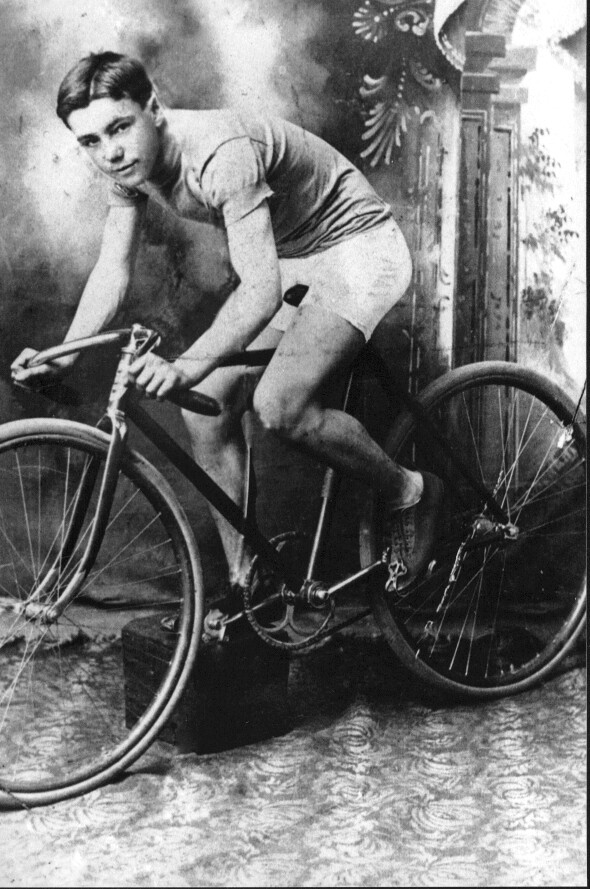
Joe Hancock, Local Racer. City of Victoria Archives 98207-15-541 M05801.
Copyright 2009. Jason Chisholm
When trying to analyze the link between bicycle racing and modernity, we have to be aware that many conclusions about this issue are subjective. Some would argue that bicycles promoted the construction and organization of better roads, racetracks, and public events. Indeed this would seem true in many cases. However, the bicycle racing era was slow to modernize the social world of the 1890’s. Norcliffe would argue that while some women enjoyed the benefits of cycling as a leisure activity, few were competing on the racetrack. With the rare exception, riders in the 1880’s were men, partly due to the Victorian style dress and expected behaviors, and partly due to the tendency of men to turn the activity into a male bonding activity.(8) Supporting evidence of this view can be seen in many photographs taken from this era, which contain strong masculine overtones such as, “the men racing on the Peterborough race track, the Bluenose Tour of 1886, Notman’s photographs highlighting the technical aspects of the machines, and the riders taking a breather on Collinwood pier.”(9) When the 1890’s rolled around with the introduction of the safety cycle, there was a social change in which many women took up cycling across Canada.(10) Cycling for leisure became a possibility for women, especially with the formation of clubs. Despite these changes, the cycling experience for women generally would not cross the border between leisure and sport. There were very few women in racing during our time period between the 1890’s and 1900’s. Additionally, there was no evidence of women competing alongside or even at the same events as Joe Hancock and his team. While womens' racing would take time to develop, the female cycling clubs flourished. By putting women on par with men, these clubs taught women how to cope with modernity. Through the bicycle, women could use their moral instincts to learn to be responsibly modern.(11)
Joe Hancock started his cycling career as a young amateur racing on Victoria’s premier bicycle track in Oak Bay. His early career consisted of racing local talent as well as international riders from the United States. Hancock was competing during the peak of bicycle racing, when new tracks were being built, and stands were full enthusiastic spectators. The races were fast and competitive, with each man trying to set new record times for the mile stretch. The British Colonist captures the essence of Hancock’s early cycling career along with the atmosphere that bicycle racing brought to Victoria.
“Victoria riders swept the amateur card in the bicycle races at Oak Bay track yesterday, which is a record to be proud of, when such men as Cooper Harrold, Norton and Selby Henderson are numbered among the contestants. In the professional class Frank J. Cotter, the New
Westminster Champion, proved the star, with Hall of Omaha his most dangerous opponent. The weather was bright, and the track in perfect order; a well-filled grand-stand watched the sport; the band was agreeably in evidence, and the races were disposed of with promptness and precision- but the wind blew a gale and it was harder to ride a mile in 2:25 than without the wind it would have been put to a 2 minute mile.”(1)
“In the amateur class it was a great day for the Perfect and the town. Joe Hancock rode to victory on it in the novice race; Penwill on it took the two thirds open; Ford Thompson, still another Perfect rider, won the open mile; and Thompson and Parr on a 104-geared Percet tandem defeated Henderson and Harrold on the two-seater.”(2)
“The novice race brought forth a string of four, Morrisey making the pace when the bell lap was started. He was given battle in the fight with the wind on the last turn and up the stretch by Hancock and Jenkins, and the final struggle was between these two boys. Hancock won out by inches in a driving finish.”(3)
Hancock began riding in the late 1890’s and continued well into the 1900’s. Referencing Norcliffe’s piece, we can infer that like other Canadian cities, Victoria was home to a group of young cyclists that for once had the opportunity to purchase and ride bicycles. During the 1880’s and early 1890’s bicycles were reserved for the elite. Norcliffe writes, “The youths riding and racing high bicycles were often the scions of leading Canadian families whose parents presumably purchased the bicycle and accessories to go along with it.”(4) Unlike Charlie Miner and the early riders in Victoria, the young men of Hancock’s generation likely had the opportunity to cycle and compete regardless of their social or economic background. The turn of the 19th century kicked off a racing culture that for the first time included younger men and women with varying social and economic backgrounds. Hancock was one of many younger men who helped to grow the sport of bicycle racing; he was considered to be Victoria’s finest up and coming racing stars.
“Joe Hancock, Victoria’s crack amateur bicycle rider, who had been doing remarkably good work on the Sound tracks this summer, will attempt to break the mile track record of 2:04, help by Otto Ziegier. Hancock will be paced by a quad ridden by Messers, Thompson, Jackson, Bartlett and Beaumont. This team and Hancock have been training together for some time and some of their speed trials have been very good. On Thursday evening they went the half mile in 53 seconds, which, considering the present condition of the tracks, is wonderful."(5)
Indeed, Hancock and his young teammates propelled bicycle racing to new heights, turning the new sport into a spectacle. Bicycle racing would eventually be showcased at summer gatherings, and baseball games. Hancock’s record mile attempt was featured at the opening of an international baseball game hosted in Victoria; "The mile was made in 2:06. The boys expect to have no trouble doing the mile in 2:01. This exhibition will take place at 2:45, and the ball game will be called at 3.”(6) The cycling craze of the 1890’s and 1900’s had a significant impact on international racing competition between Canada and the United States. Hancock and various members of the Oak Bay cycling team would train and compete against top American racers. The competition between racers on the west coast was popular enough that tracks began springing up on both sides of the border.
“The new board bicycler track at Port Townsend was opened on Saturday last; a number of riders from the Sound cities and Victoria contesting in the initial meet. Among the number were Joe Hancock, W. Northcott, D. Thompson and Jackson, from Victoria. The first race, a one mile open professional, was won by F.J Cotter, with Virgil Hall second. The next event, the two mile handicap, was won by P. Rust of Olympia, Joe Hancock of Victoria being second, and Avery of Olympia third.”(7)


