Images of Ben Jonson
Karen Hearn
Various pieces of evidence suggest what Ben Jonson looked like. They are fragmentary, and in some cases conflicting, but overall our current state of knowledge offers a reasonable impression of his appearance. This is more than can be said for many of his writer contemporaries.
John Aubrey stated that ‘Ben Johnson had one eye lower than tother and bigger’ and that he ‘was (or rather had been) of a clear and fair skin; his habit was very plain. I have heard Mr Lacy the Player say, that he was wont to wear a coat like a coachman’s coat, with slits under the armpits' (Life Records, Aubrey). In 1619 Jonson described himself as having a ‘mountain belly, and … rocky face' (Underwood, 9.17). Both William Drummond of Hawthornden (Informations, 556-7) and Aubrey noted Jonson’s fondness for drink, which may have had an effect on his appearance.
Only one secure image of Jonson survives. Many versions of it are extant, of which the one in the National Portrait Gallery, London (hereafter NPG), is now generally accepted as the original ( ).
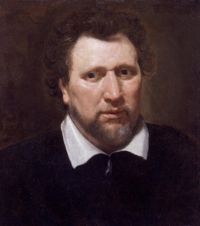
Portrait 1. Ben Jonson, Abraham van Blyenberch, painted portrait (National Portrait Gallery, London ref no. 2752). Reproduced by permission of the National Portrait Gallery, London. © National Portrait Gallery, London

Portrait 1. Ben Jonson, Abraham van Blyenberch, painted portrait (National Portrait Gallery, London ref no. 2752). Reproduced by permission of the National Portrait Gallery, London. © National Portrait Gallery, London
In or around 1627, it formed the basis for an engraving by Robert Vaughan ( the encircling Latin lettering on which described it as ‘VERA EFFIGIES DOCTISSIMI POETARVM ANGLORVM BEN: IOHNSONII’: ‘an accurate likeness of Ben Jo[h]nson, most learned of the English poets’ (translation by Dr Keith Cunliffe).
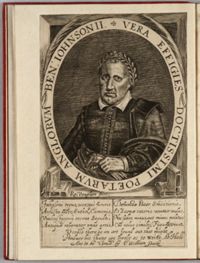
Portrait 2. Ben Jonson, Robert Vaughan, engraving, from Execration of Vulcan and Epigrammes (Huntington Library copy) [Acknowledgements]

Portrait 2. Ben Jonson, Robert Vaughan, engraving, from Execration of Vulcan and Epigrammes (Huntington Library copy) [Acknowledgements]
The NPG portrait is painted on canvas, and depicts its subject almost face on, looking directly out at the viewer. This confers a somewhat confrontational air –consistent with what is known of Jonson’s personality. He is simply dressed, suggesting the plain habit mentioned by Aubrey, and his eyes do appear to be at differing levels. There is a wart to one side of his nose (as seen by the viewer, the right-hand side). It is a head-and-shoulders portrait, which means that Jonson's bulky torso is not shown. Its dimensions are 47cm high by 41.8cm wide (18 3/8 x 16 3/8 inches). The painting was cleaned and conserved in 1984, since when it has been possible to assess its content and calibre more clearly.
It is thought to be the picture referred to, in an inventory taken in 1635 of the paintings at York House in London (where it hung ‘In the Passage by the Ladies’ Closet’, among paintings attributed to Rubens), as ‘Blyenberke. – A Picture of Ben Jonson’ (Davies, 1906-7, 380). York House had belonged to George Villiers, first Duke of Buckingham, and the contents are presumed to have remained there following his death in 1628.
According to this inventory, the first Duke kept only seventeen portraits at York House (his main London residence, at the west end of the Strand). The majority of the paintings there were Italian and Flemish works of classical, biblical, and other narrative subjects. It is intriguing that Buckingham should own a portrait of Jonson, with whom he was particularly in contact during 1621, when Jonson’s masque The Gypsies Metamorphosed was performed at Buckingham’s estate in Rutland, Burley-on-the-Hill.
It is not clear what happened subsequently to Buckingham’s portrait of Jonson (for the collection and its dispersal, see Betcherman, 1970; McEvansoneya, 1986; McEvansoneya, 1994; and McEvansoneya, 1996). It is not specifically mentioned in the list of paintings sold in Antwerp in 1650 on behalf of Buckingham’s son, the 2nd Duke (Duverger, 1984-2005, 5.70-77). The early history of the NPG portrait is not known. Prior to its purchase in 1935 from a London art dealer, Sydney Wise, it had been owned by a Henry Bates of Salisbury, and before that said to have been at Oldstock House, Wiltshire, the residence of the Webb baronets. Successive heirs to this baronetcy, which was created in 1644 and became extinct on the death of the seventh baronet in 1874, had married into the Caryl, Blomer, Belasis, Moore, Gibson, Salvin, Dillon, Boyne and Somerville families (Cokayne, 1900-6, 2.220-1).
Stylistically it is plausible that the Netherlandish artist named in the 1635 inventory, Abraham van Blyenberch, painted the NPG portrait. Comparisons can be made with the handling of his signed portrait of William Herbert, Third Earl of Pembroke, 1617, who was also a patron of Jonson (at Powis Castle; reproduced in Hearn, 1995, 204-5). Van Blyenberch (1575/6-1624) was born in the Spanish Netherlands. By late 1617 he was living in Antwerp, from where he evidently set off for London. There he portrayed some of the most elite members of the court: not only Pembroke, but also Robert Ker, later first Earl of Ancrum, in 1618, and Charles, Prince of Wales, later Charles I, c.1617-20. In 1621 or 1622 he returned to Antwerp, where he died late in 1624 (ODNB).
This means that van Blyenberch’s portrait of Jonson must date from no later than 1621/22. Given the lack of grey in the sitter’s hair – there are just a few silver threads at his right temple, and in his beard – it seems plausible to speculate that Jonson is shown in his mid-forties, suggesting an approximate date of c.1618. Blyenberch’s surviving portrait of Prince Charles, particularly, is characterised by a baroque ebullience, and it seems somewhat unexpected that this artist should have been commissioned to produce such a simple representation of the soberly attired Jonson.
A considerable number of copies and versions of the NPG head-and-shoulders image of Jonson survive. These include one at Welbeck Abbey (first recorded in 1741: see Goulding, 1936, cat. no. 3), and another at Knole, Kent (first recorded in 1728; Strong, 1969, lists many of the versions and derivations). Gilchrist in 1816 refers to one ‘in the picture gallery at Oxford’ (Gifford, 1816, 1.ccclx). This painting was among the various portraits in the Bodleian Library that the Dutch-born mezzotint-maker John Faber I (c.1660-1721) engraved following his visits to Oxford in 1711 and 1712. It was at that time, probably erroneously, attributed to the London-born Cornelius Johnson painter (no relation to the poet) (J. C. Smith, 1883, 269). By 1912, this painted portrait seems to have been lost, and the only portrait of Jonson by then in the Bodleian was one presented only in 1732 by Dr George Clarke (Poole, 1912-25, 1.129, 40).
Another version, now unidentified, was in the collection of John, Lord Somers (1651-1716). It was engraved in 1711 by George Vertue ( who erroneously attributed it to the Dutch artist ‘Gerard van Honthorst’ (1592-1656). The slight turn of the sitter’s head and body to the viewer’s right is reversed in this engraving, so that Jonson inclines instead towards our left; it includes more of Jonson's torso than does the NPG portrait, showing his upper arms and a mantle looped over his right shoulder. This engraving, in turn, seems to have been copied by subsequent painters, and thus to have been the basis for some of the later images of Jonson. For instance, a portrait miniature of Jonson in the Royal Collection, which is paired with a miniature of the writer John Fletcher (1579-1625), both by the same unknown painter, may have been based on Vertue's engraving (Reynolds, 1999, 108-9 [cat. nos. 78 and 77]).
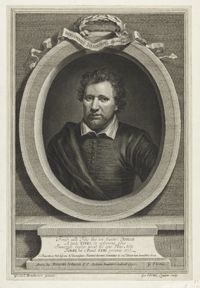
Portrait 3. Ben Jonson, George Vertue, after ‘Gerard Honthorst’, 1730, engraving. (Fitzwilliam Museum, Cambridge) [Acknowledgements]

Portrait 3. Ben Jonson, George Vertue, after ‘Gerard Honthorst’, 1730, engraving. (Fitzwilliam Museum, Cambridge) [Acknowledgements]
A version of the NPG portrait – probably, again, after Vertue’s engraving, given the direction in which the head is turned – seems to have been used by the architect James Gibbs c. 1723 in his design for a monument to Jonson in Westminster Abbey (). The monument, whose execution is attributed to the sculptor Michael Rysbrack, was commissioned by Edward Harley and erected in the eastern aisle of Poets’ Corner (Friedman, 1984, 99-100, 314).
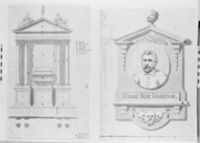
Portrait 4. James Gibbs, Design for the Monument to Ben Jonson, c.1723 (Ashmolean Museum, Oxford) [Acknowledgements]

Portrait 4. James Gibbs, Design for the Monument to Ben Jonson, c.1723 (Ashmolean Museum, Oxford) [Acknowledgements]
The NPG type was also used as a basis for much freer, sometimes more elaborate, later images. These include one that shows Jonson seated in front of a window opening with curtains, a quill pen in his right hand, and a book under his left arm as he leans against a book-covered table. Formerly in the collection of the Viscounts Clifden, at Wimpole Hall, Cambridgeshire, this painting is now at the University of Texas at Austin. Based on this work was an engraving that describes the original as being in the collection of the [third] Earl of Hardwicke (whose forebear had purchased Wimpole Hall in 1740), and which was drawn by J. Thurston, engraved by C. Warren and published by W. Walker in 1820. (O’Donoghue, 1908-25, 2.661-2 gives an extensive list of the various portrait prints of Jonson.)
One, or possibly two, further portraits of Jonson are known once to have existed, but are now lost. In January 1619, following his return from his visit north, Jonson wrote verses on ‘My Picture left in Scotland’, in which he mentions ruefully his ‘hundred of grey hairs’, ‘mountain belly’, and ‘rocky face' (Und. 9.14, 17). If this was an actual picture, it could have been a small, portable image, perhaps a portrait miniature. Many commentators have assumed, however, that this was in fact a self-portrait in verse form.
Also in The Underwood, Jonson wrote in verse to a friend, Sir William Borlase (or Burlase), who had drawn or painted a portrait of him. Again he alludes to his own ‘prodigious waist’, which he says makes his back stoop, and tells his friend that in striving to make it ‘An archetype, for all the world to see, / You made it a brave piece, but not like me’ (Und. 52b.1, 14-15). There was more than one gentleman named Sir William Borlase, Burlase, or Burlacie at this period (W. A. Shaw, 1906, 111, 166), but Jonson’s friend is assumed to be the one based at Little Marlow, Buckinghamshire. The founder of Sir William Borlase’s School at Great Marlow, he was appointed Sheriff of Buckinghamshire in 1601, knighted in 1603, and died in 1629 (Page, 1905-28, VCH Buckinghamshire, 3.80; his will, dated 29 August 1628, is in the National Archives, PROB 11/156). He is not otherwise known to have been an artist and it is not known what happened to his image of Jonson.
A number of painted portraits have been claimed inaccurately to depict Jonson, for instance the Unknown Man, in the collection of the Folger Shakespeare Library in Washington. The most significant misidentification of a portrait as of Jonson had occurred by at least the early eighteenth century. The original, in which the bearded subject turns to gaze at the viewer over his right shoulder, is now known in fact to be an early 1620s self-portrait miniature by Peter Oliver (1594-1647) (Reynolds, 1999, 106). In 1738, it was engraved by Jacobus Houbraken as an image of Jonson (). It appeared under this title in Thomas Birch’s Heads of Illustrious Persons of Great Britain (1747-52), naming Isaac Oliver as the artist and the owner of the original as Dr Richard Mead (1673-1754). This engraving, too, was copied by those who wanted to have an image of Ben Jonson, both in smaller engraved form and in paint. It was, for instance, clearly the basis for a second portrait at the Folger that was formerly called Jonson, which is thought to date from no earlier than the mid-eighteenth century (Pressly, 1993 336-7).

Portrait 5. Self-portrait, engraving by Jacobus Houbraken, 1738, after Peter Oliver portrait miniature formerly erroneously thought to depict Jonson (Martin Butler collection) [Acknowledgements]

Portrait 5. Self-portrait, engraving by Jacobus Houbraken, 1738, after Peter Oliver portrait miniature formerly erroneously thought to depict Jonson (Martin Butler collection) [Acknowledgements]
As mentioned previously, the NPG image-type of Jonson had been used as a basis for the earliest known engraving of the poet’s features, which was executed by Robert Vaughan (c.1600-before 1663/4), with verses beneath by Abraham Holland (died 1626). George Humble had issued this as an individual print by or in 1627 (H&S, 11.591-2; Hind, 1952-64, 3.33, and plates 26c-d). Holland’s verses are as follows:
Johnsoni typus, ecce! qui furoris.
Antistes sacer, Enthei, Camenis
Vindex frigenij recens Sepulti,
Antiquae reparator vnus artis,
Defuncta Pater Eruditionis,
Et Scenae veteris novator audax.
Nec faelix minus, aut minus politus
Cui solus similis, Figura, vivet.
O could there be an art found that might
Produce his shape soe lively as to Write.
The Latin may be rendered as ‘Behold the image of Jonson, high priest of the inspiring muse, new champion of old wisdom and restorer of ancient arts, patron of learning, and bold renewer of the antique stage. Let this image live, no less happy or accomplished, than its great original’ (transl. Keith Cunliffe). The process of engraving means that Jonson is again seen turned to the viewer’s left, rather than to the right. The print shows him crowned with a laurel wreath, and at half-length, so that both his arms are included, the left one draped with a mantle, which seems also to extend round his waist. In his left hand, Jonson grasps a pair of gloves, a sign of status. In the second state of this print Humble’s address had been removed and replaced by ‘Are to be sould by William Peake’.
In 1640, a laurel-wreathed bust image of Jonson in a fictive niche was engraved by ‘W.M.’ (William Marshall, active, c.1617-c.1650) as the frontispiece to Jonson's posthumously published Q. Horatius Flaccus: His Art of Poetry. Englished by Ben: Jonson. With other Workes of the Author, never Printed before, London, 1640 ( In emulation of a piece of classical sculpture, Jonson is shown naked, although only his shoulders are seen, cut off at the top of the arms, draped with a tiny swag of fabric (Hind, 1952-64, 3.119, 169).

Portrait 6. Ben Jonson, William Marshall, engraving: frontispiece to Q. Horatius Flaccus: His Art of Poetry. Englished by Ben: Jonson. With other Workes of the Author, never Printed before (1640) [Acknowledgements]

Portrait 6. Ben Jonson, William Marshall, engraving: frontispiece to Q. Horatius Flaccus: His Art of Poetry. Englished by Ben: Jonson. With other Workes of the Author, never Printed before (1640) [Acknowledgements]
The oval section of the Vaughan image, reversed, was subsequently engraved by William Elder and appeared as the frontispiece to the 1692 edition of Jonson's Works (; H&S, 6.ix-x).

Portrait 7. Ben Jonson, William Elder, engraving: frontispiece to The Works of Ben Jonson (1692) [Acknowledgements]

Portrait 7. Ben Jonson, William Elder, engraving: frontispiece to The Works of Ben Jonson (1692) [Acknowledgements]
At the beginning of the nineteenth century, there appeared a half-length, and rather richly costumed, engraved image of Jonson, turned to the viewer’s right. By now rather distantly based on the NPG type, its face distinctly coarsened, this was subsequently engraved by E. Scriven from ‘a Picture in the Possession of Mr Knight’ (who is currently unidentified). This was re-engraved by W. Holl as an even cruder version, with rough features and a large bulbous nose, which was published in 1863.
Apart from the images that have been misidentified as being of Ben Jonson – and the one or possibly two other pictures to which he himself alluded and which have apparently been lost – a reasonably consistent iconography emerges, based on a single type. Current evidence suggests that the original is the painting now in the National Portrait Gallery, which presents an unusually robust depiction of this remarkable writer.
Portraits
1. Ben Jonson, Abraham van Blyenberch, painted portrait (National Portrait Gallery, London ref no. 2752)
2. Ben Jonson, Robert Vaughan, engraving - State I
3. Ben Jonson, George Vertue, after ‘Gerard Honthorst’, 1730, engraving (© The Fitzwilliam Museum, Cambridge)
4. James Gibbs, Design for the Monument to Ben Jonson, c.1723 (Ashmolean Museum, Oxford)
5. Self-portrait, engraving by Jacobus Houbraken, 1738, after Peter Oliver portrait miniature formerly erroneously thought to depict Jonson (Martin Butler collection)
6. Ben Jonson, William Marshall, engraving: frontispiece to Q. Horatius Flaccus: His Art of Poetry. Englished by Ben: Jonson. With other Workes of the Author, never Printed before (1640)
7. Ben Jonson, William Elder, engraving: frontispiece to The Works of Ben Jonson (1692)
National Portrait Gallery, ref. no. 2752, see H&S, 5.xi-xiii, and Strong (1969), 183. For many years, the painting was erroneously associated with the name of the Dutch painter Gerrit van Honthorst (see below).
I am also grateful to James Knowles for discussing this question with me.
NPG file notes; see also Strong, 1969. It has not proved possible to connect it with any of the versions mentioned by Octavius Gilchrist in his essay ‘Portraits of Jonson’ in W. Gifford, ed., The Works of Ben Jonson (1816), 1.ccclvii-ccclx.
See Strong (1969), 184. Jonson’s portrait was at Wimpole by 1734, where it was noted by Sir John Evelyn in a diary entry for 3 January 1734: see Mack (1985), 882 n.380; at that date Wimpole belonged to Edward Harley, later 2nd Earl of Oxford (1689-1741). The portrait was offered at Christie’s 30 June 1888 (as lot 60, implausibly attributed to Cornelius Johnson, see H&S, 11.292) but presumably was unsold and subsequently acquired with Wimpole Hall in 1894 by the future 6th Viscount Clifden. It is reproduced in Piper (1968), plate IX.
See. Pressly (1993), 337-8, where the sitter is described as ‘inoffensively handsome’ and thus lacking the ‘charged emotions and florid bulk’ discerned in the Blyenberch Jonson. The painting, which has a French provenance, had suffered earlier abrasion and much retouching; I am very grateful to Dr Erin C. Blake for making its condition report available to me.
Although the sitter’s collar in it is completely different, the similar distortion of the facial features suggests that this print may have some connection with a painted portrait, 50 x 40 in, formerly in the collection of Sir Berkeley Sheffield, sold Christie’s 16 July 1943, lot 113, and again Christie's, London, 24 November 1978, lot 67 (photograph in NPG Archive). This painting evidently derives, at some distance, from the NPG type. It shows Jonson at three-quarter-length holding an inscribed paper, with a curtain to the left and vertically shelved books to the right; see H&S, 11.90-91. It is reproduced in Piper (1968), as plate VIII; according to Piper, 58 n.1, it was first recorded in the collection of John Sheffield, 1st Duke of Buckingham in 1721. From a photograph alone it is difficult to determine when this work was painted; an annotation in the NPG Archive’s copy of the Christie’s 1978 sale catalogue indicates that the late E. K. Waterhouse had suggested that it might be by Isaac Fuller (c.1620-1672).